Destination
Bolu Müzesi
In the museum located in the Cultural Center belonging to the Provincial Directorate of Culture and Tourism, as of 2018, there are a total of 17083 works, including 3351 archaeological works, 1627 ethnographic works and 12105 coins. The Museum, located on the ground floor of the Cultural Center building, consists of 2 sections: the archaeology hall and the ethnography hall.
Bolu Müzesi and 6 places around it
Free · no sign-up needed
Highlights
- Museum
- Culture
Good for
- Museum visits
Suggested visit:45 minutes
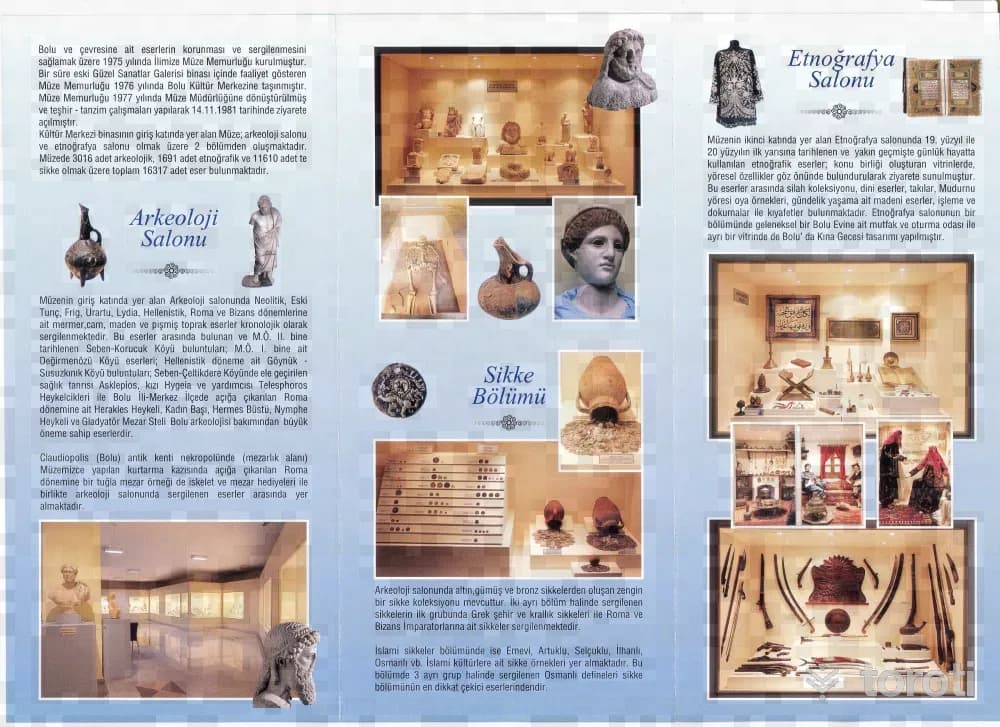
The museum, located in the Cultural Center belonging to the Provincial Directorate of Culture and Tourism, contains a total of 17083 works as of 2018, including 3351 archaeological works, 1627 ethnographic works, and 12105 coins. The Museum, located on the ground floor of the Cultural Center building, consists of 2 sections: the archaeology hall and the ethnography hall.
ARCHAEOLOGY HALL: In the Archaeology hall located on the ground floor of the museum, marble, glass, metal, and terracotta works from the Neolithic, Early Bronze, Phrygian, Urartian, Lydian, Hellenistic, Roman, and Byzantine periods are exhibited chronologically. Among these works, the finds from Seben-Korucuk Village dated to 2000 BC; the works from Değirmenözü Village belonging to 1000 BC; the finds from Göynük-Susuzkınık Village from the Hellenistic period; the statuettes of the god of health Asklepios, his daughter Hygeia, and his assistant Telesphoros unearthed in Seben-Çeltikdere Village; and the Roman Period Herakles Statue uncovered in Bolu Province-Central District, the cult statue head made of crystalline white marble, which is the only example in our country, the Hermes Propylaios Bust, the Nymphe Statue, and the Gladiator Grave Stele are works of great importance for Bolu archaeology. A brick tomb from the Roman Period uncovered in the rescue excavation carried out by our Museum in the necropolis (burial area) of the ancient city of Claudiopolis (Bolu) is also among the works exhibited in the archaeology hall together with its skeleton and grave gifts.
There is a rich coin collection consisting of gold-silver and bronze coins in the archaeology hall. In the first group of coins, exhibited in two separate sections, coins of Greek cities and kingdoms and coins belonging to Roman and Byzantine Emperors are exhibited. In the Islamic coins section, there are examples of coins belonging to Islamic cultures such as Umayyad, Artuqid, Seljuk, Ilkhanid, Ottoman, etc. In this section, the Ottoman hoards exhibited in 3 separate groups are among the most striking works of the coin section.
ETHNOGRAPHY HALL: In the Ethnography hall located on the second floor of the museum, ethnographic works used in daily life in the recent past and dated to the 19th century and the first half of the 20th century are presented to visitors in display cases forming thematic unity, taking regional characteristics into consideration. Among these works are a weapon collection, religious works, jewelry, examples of lace from the Mudurnu region, metal works related to daily life, embroidery and weavings, and clothing. In one section of the Ethnography hall, a kitchen and sitting room belonging to a traditional Bolu House and, in a separate display case, a Henna Night design in Bolu have also been created.
MUSEUM GARDEN: Large-sized stone and terracotta works registered in the museum inventory are exhibited in the Museum garden. The works exhibited in the garden belong to the Roman, Byzantine, and Ottoman periods. Among these works are sarcophagi, grave steles, statue bases, columns, column bases, column capitals, frieze, architrave, etc. architectural elements from the Roman period; architectural pieces such as a baptismal font, etc. from the Byzantine period; and inscribed gravestones from the Ottoman period. Roman period graves and sarcophagi and Ottoman period gravestones uncovered in the rescue excavations carried out by our Museum have been presented for public visit in groups in the Museum garden together with panels containing their explanations in Turkish and English. Source: Bolu Museum Directorate Archive.
Last updated: 22 October 2026
Location and surroundings
Bolu Müzesi sits within Bolu Merkez, Bolu. The toroti catalogue holds 57 described stops across Bolu, 31 of them in Bolu Merkez.
The nearest stop is Karamanli Camii, 110 m to the southwest. Another 6 catalogued points lie within a 30 km radius.
The Istanbul – Bolu route passes 760 m away, so this works as a stop along the drive.
See Bolu Müzesi and its surroundings in one plan
- Order your stops on the map and spread them across days
- See driving and visiting time at a glance
- Get places around it suggested automatically
- Free — no sign-up needed to start
Other places nearby
Routes that pass close by
Frequently asked
- What is Bolu Müzesi?
- In the museum located in the Cultural Center belonging to the Provincial Directorate of Culture and Tourism, as of 2018, there are a total of 17083 works, including 3351 archaeological works, 1627 ethnographic works and 12105 coins. The Museum, located on the ground floor of the Cultural Center building, consists of 2 sections: the archaeology hall and the ethnography hall.
- Where is Bolu Müzesi?
- Bolu Müzesi is in Bolu Merkez, Bolu.
- How long does it take to visit Bolu Müzesi?
- The suggested visit time for Bolu Müzesi is about 45 minutes.
- What else is there to see near Bolu Müzesi?
- toroti’s catalogue holds other destinations within 30 km of Bolu Müzesi; the closest are Karamanli Camii, Saraçhane Cami, Yukarı Taşhan.
- Is Bolu Müzesi on the way anywhere, and which route?
- Bolu Müzesi lies 760 m from the Istanbul – Bolu route, close enough to add to that drive with a short detour.