Destination
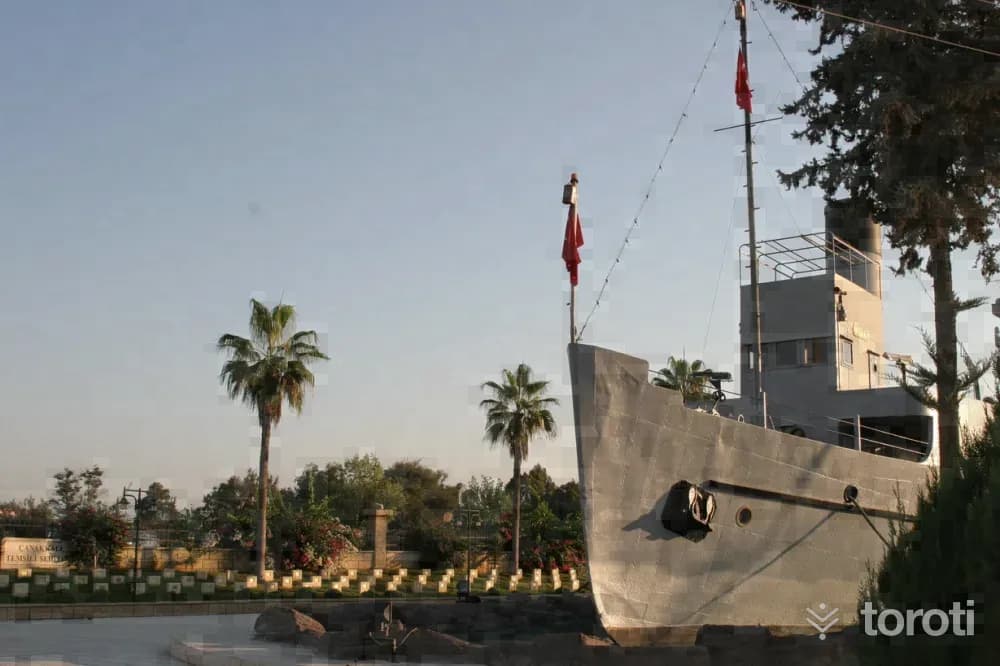
Nusrat Mayin Gemisi
The mines laid by Nusrat changed the fate of the Battle of Çanakkale on 18 March 1915, earning it the title of "the world's most famous minelayer." With its crew of 639, Nusrat's mines sent the battleships Bouvet, followed by Inflexible and Bolva, to the bottom.
Nusrat Mayin Gemisi and 6 places around it
Free · no sign-up needed
Highlights
- Local culture
Suggested visit:45 minutes
The mines laid by Nusrat changed the fate of the Çanakkale War on 18 March 1915, earning it the title of "the world's most famous minelayer." Nusrat's mines sent Bouvet, followed by the battleships Inflexible and Bolva, to the bottom with their crews of 639 men.
From the first volume of the English General Oglander’s work titled "Çanakkale-Gelibolu Askeri Harekatı" (Military Operations Gallipoli, Official History of the Great War): "The day, which had begun very auspiciously, ended in complete failure because of the extraordinary and devastating success of this unknown mine line. The effect of these twenty mines on the fate of the campaign is immeasurable."
From the second volume of Sir Ccolyen Corbet’s work titled "Deniz Harekatı": "It did not take long before the true cause of the disasters was discovered and determined. The truth was that on the night of 8 March the Turks had, without our knowledge, laid 20 mines parallel to Erenköy Koyu, and our reconnaissance vessels had not encountered them during their search. The Turks had placed these mines in our maneuvering area for a special purpose, and despite all the precautions we took, they won a dizzying victory."
In 1930, Minister of the Navy Winston Churchill commented on the event in the magazine "Revue de Paris" as follows: "The main reason why so many people died in the First World War, why the war came at such heavy cost, and why so many merchant and warships sank at sea, was those twenty iron containers swinging at the end of a slender steel cable thrown that night by the Turks."
Nusrat was brought by truck from Mersin to Tarsus in three pieces, and the 27 kilometer journey took 4.5 hours. After Nusrat was moored at Çanakkale Parkı, which was built for it, an 8-person committee examined its model in Çanakkale and researched all sources, and as a result it was restored to the form closest to the original.
Source: Mersin Provincial Directorate of Culture and Tourism archive.
Places to Visit in Mersin Address: Tarsus Şehir Girişi (Mersin tarafından gelişte) Tarsus Çanakkale Parkı Tarsus / Mersin
Last updated: 21 October 2026
Location and surroundings
Nusrat Mayin Gemisi sits within Tarsus, Mersin. The toroti catalogue holds 130 described stops across Mersin, 30 of them in Tarsus.
The nearest stop is Gözlükule Höyük, 850 m to the northeast. Another 6 catalogued points lie within a 30 km radius.
The Mersin – Adana route passes 4.5 km away, so this works as a stop along the drive.
See Nusrat Mayin Gemisi and its surroundings in one plan
- Order your stops on the map and spread them across days
- See driving and visiting time at a glance
- Get places around it suggested automatically
- Free — no sign-up needed to start
Other places nearby
Routes that pass close by
Frequently asked
- What is Nusrat Mayin Gemisi?
- The mines laid by Nusrat changed the fate of the Battle of Çanakkale on 18 March 1915, earning it the title of "the world's most famous minelayer." With its crew of 639, Nusrat's mines sent the battleships Bouvet, followed by Inflexible and Bolva, to the bottom.
- Where is Nusrat Mayin Gemisi?
- Nusrat Mayin Gemisi is in Tarsus, Mersin.
- How long does it take to visit Nusrat Mayin Gemisi?
- The suggested visit time for Nusrat Mayin Gemisi is about 45 minutes.
- What else is there to see near Nusrat Mayin Gemisi?
- toroti’s catalogue holds other destinations within 30 km of Nusrat Mayin Gemisi; the closest are Gözlükule Höyük, Tarsus Müzesi, Kleopatra Kapisi.
- Is Nusrat Mayin Gemisi on the way anywhere, and which route?
- Nusrat Mayin Gemisi lies 4.5 km from the Mersin – Adana route, close enough to add to that drive with a short detour.