Destination
Şebinkarahisar Fatih Camii
According to sources, it is written that it began to be built when Fatih Sultan Mehmet came to Şebinkarahisar after winning the Battle of Otlukbeli on 29 August 1473 and that it was completed in five years. It is stated that the mosque was first built of wood, burned down twice, and was renewed with stone material after these fires. Sources record that today's Fatih Camii was commissioned by Rasih and Mahmut Paşas in 1888.
Şebinkarahisar Fatih Camii and 6 places around it
Free · no sign-up needed
Highlights
- Faith heritage
Good for
- Heritage walks
Suggested visit:45 minutes
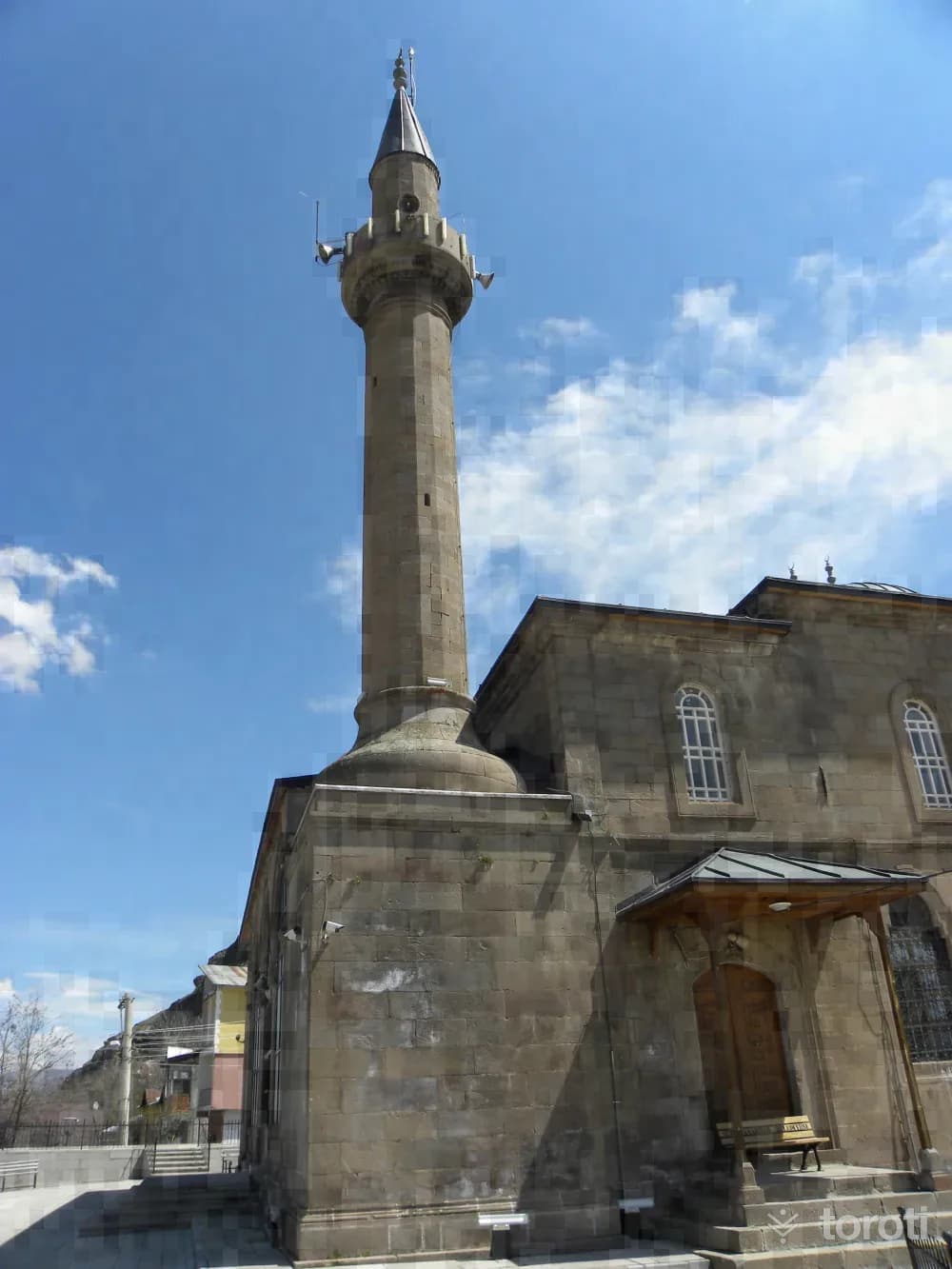
According to sources, it is written that it began to be built when Fatih Sultan Mehmet came to Şebinkarahisar after winning the Battle of Otlukbeli on 29 August 1473 and that it was completed in five years. It is stated that the mosque was first built of wood, burned down twice, and was renewed with stone material after these fires. Sources record that today’s Fatih Camii was commissioned by Rasih and Mahmut Paşas in 1888. The domes of the mosque, which collapsed in the 1939 earthquake, were repaired in 1950, and the building also underwent a minor repair in 1977. Located on a high terrace and within a large courtyard, the building was constructed on a longitudinal rectangular plan in the north–south direction (17.70 X269,60 meters). Built entirely of smoothly cut stone material, the structure was plastered and painted on the inside. The three-bay last congregation area on the north façade of the mosque, resting in the middle on two monolithic stone columns, is today enclosed with glass.
The prayer hall is entered through a rectangular, low-arched, double-leaf wooden door. The gallery located directly above the entrance is reached by 15-step staircases on both sides of the entrance. The middle section of the gallery is arranged in the form of a barrel vault running east-west, while the side sections are arranged as cross vaults, and each section projects forward in a semi-circular form. The wooden railings consist of rows of inverted palmettes below. In the interior, the wall surfaces are plastered and painted. There is no decorative element. The wall surface on the south side is divided into three sections by round arches resting on pilasters. The stone mihrab in the middle of the wall surface has a polygonal niche and a muqarnas semi-dome of seven tiers. In the triangular spandrels of the semi-dome are vegetal motifs painted in gold leaf. On the rectangular panel above the semi-dome is the inscription “Küllemâ dehale aleyhâ Zekeriyye’l-Mihrâb” (Whenever Zechariah entered upon her in the prayer niche…) taken from verse 37 of Surah “Âl-i İmran”.
The triangular side panel part of the minbar is plain. The railing section, however, has five square panels side by side, and within these square panels there is one circular motif each. The kiosk section rests on four columns with hexagonal bodies. The minbar ends with a glass cone after a cornice consisting of a plain molding and a row of tooth motifs above it. The stone decorations on the minbar are decorated with gold leaf.
The main space of the mosque is covered with a central dome in the middle carried by four columns, one small dome at each of the four corners of the central dome, and barrel vaults between the small domes. In addition to this, if we count the two columns in the north and the cross vaults in the corners, together with the barrel-vaulted entrance in the middle, the number of coverings and columns increases in the three-aisled mosque. The columns carrying the upper covering have muqarnas capitals and are connected to each other and to the engaged supports in the walls by pointed arches. The eight rectangular, round-arched windows in the drum of the central dome make a major contribution to the lighting of the interior. Its minaret in the northwest corner has a square base, an onion-shaped transition element, a sixteen-sided shaft, and a single balcony, and ends above with a finial resting on a مخروطical cone.
Source: Giresun Provincial Directorate of Culture and Tourism
Places to Visit in Giresun Address: Bülbül Mahallesi, Yeni Çarşı 1. Cd. No:7, 28400 Şebinkarahisar/Giresun
Last updated: 21 October 2026
Location and surroundings
Şebinkarahisar Fatih Camii sits within Şebinkarahisar, Giresun. The toroti catalogue holds 74 described stops across Giresun, 14 of them in Şebinkarahisar.
The nearest stop is Şebinkarahisar Atatürk Evi Ve Müzesi, 40 m to the west. Another 6 catalogued points lie within a 30 km radius.
See Şebinkarahisar Fatih Camii and its surroundings in one plan
- Order your stops on the map and spread them across days
- See driving and visiting time at a glance
- Get places around it suggested automatically
- Free — no sign-up needed to start
Other places nearby
Frequently asked
- What is Şebinkarahisar Fatih Camii?
- According to sources, it is written that it began to be built when Fatih Sultan Mehmet came to Şebinkarahisar after winning the Battle of Otlukbeli on 29 August 1473 and that it was completed in five years. It is stated that the mosque was first built of wood, burned down twice, and was renewed with stone material after these fires. Sources record that today's Fatih Camii was commissioned by Rasih and Mahmut Paşas in 1888.
- Where is Şebinkarahisar Fatih Camii?
- Şebinkarahisar Fatih Camii is in Şebinkarahisar, Giresun.
- How long does it take to visit Şebinkarahisar Fatih Camii?
- The suggested visit time for Şebinkarahisar Fatih Camii is about 45 minutes.
- What else is there to see near Şebinkarahisar Fatih Camii?
- toroti’s catalogue holds other destinations within 30 km of Şebinkarahisar Fatih Camii; the closest are Şebinkarahisar Atatürk Evi Ve Müzesi, Şebinkarahisar Kurşunlu Camii, Şebinkarahisar Kalesi.