Destination
Yağlidere Tekkeköy Cami
There are publications stating that the Hacı Abdullah Külliyesi was founded by Gülbahar Hatun, the mother of Yavuz Sultan Selim, during his governorship of Trabzon (1489-1512), and that its administration was left to Hacı Abdullah Halife. Of the külliye, the mosque, zaviye-hearth, guesthouse, mill, and the tomb of the founding sheikh in Tuğlacık Köyü have survived to the present day. The bakery has been removed, and an imam's house has been built in place of the zaviye guesthouse right next to the mosque.
Yağlidere Tekkeköy Cami and 6 places around it
Free · no sign-up needed
Highlights
- Faith heritage
Good for
- Heritage walks
Suggested visit:45 minutes
There are publications stating that the Hacı Abdullah Külliyesi was founded by Gülbahar Hatun, the mother of Yavuz Sultan Selim, during his governorship of Trabzon (1489-1512), and that its administration was left to Hacı Abdullah Halife. From the külliye, the mosque, zaviye-hearth, guesthouse, mill, and the tomb of the founding sheikh in Tuğlacık Köyü have survived to the present day. The oven was removed, and an imam’s house was built in place of the zaviye guesthouse right next to the mosque.
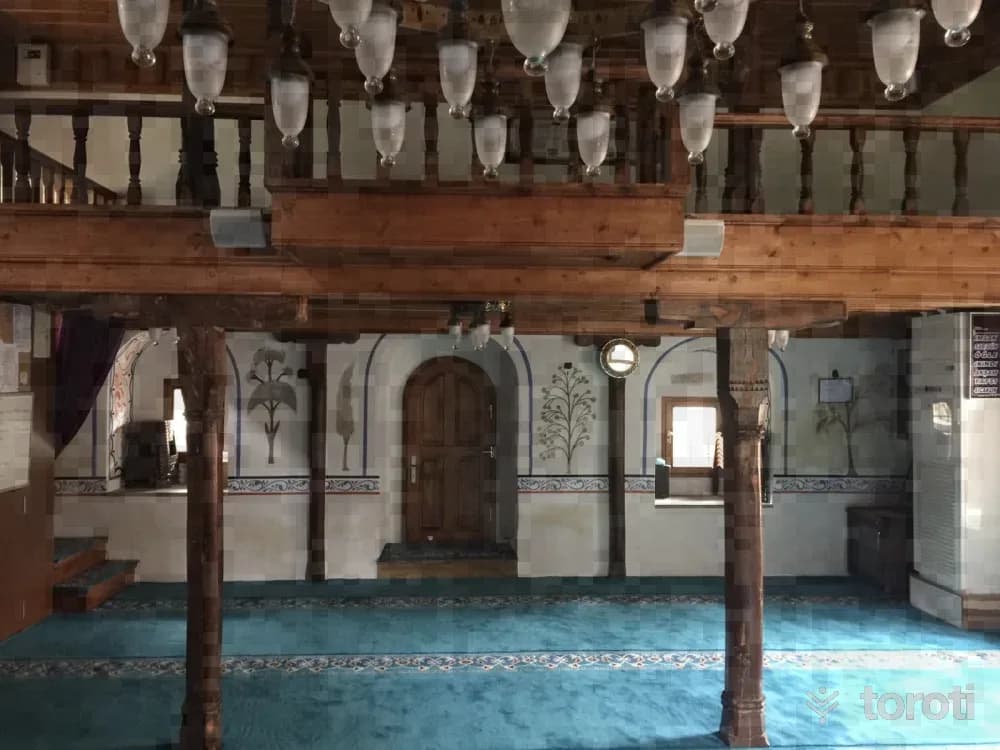
Built in a masonry system, the mosque has a longitudinal rectangular plan. The structure, consisting of a last congregation area and a square harim section, has a round-form, single-balcony minaret built in the 1980s. In terms of materials, basalt stone in rubble form was used in the main walls, and it was plastered over. The mosque is covered with a four-sided hipped roof.
In the interior, the gallery covering half of the harim section is reached by a wooden staircase located to the left of the door. The wooden ezan place reached by this staircase was demolished, and the present minaret was built in its place. The mihrab, which has a semi-circular niche, is surrounded by two rows of borders with curved branch and geometric motifs. The minbar is made of walnut. S and C curves are featured on the face on the mihrab side. There is no decoration on its other face. In this state, the minbar bears 19th century characteristics. The harim is covered with a wooden ceiling.
A rich decorative composition is seen on the walls of the harim. In the decorative composition applied in the form of kalemişi, vegetal, geometric, inscribed, and object-based ornaments dominate. Vases, oil lamps, knives, flags, curtains, mosques, clocks, depictions of paradise, the moon, stars, the sun, trees, still lifes, and flowers in various forms are among the most frequently used motifs. The wall paintings in the mosque are concentrated on the walls to the south of the gallery. Here, the walls are divided by a row of arcades consisting of columns and round arches, and the interiors of the arch bays are filled with various vegetal decorations rising from a vase or from the ground line. In this section, there are seven arch bays on the west wall, twelve on the south wall, and six on the east wall. The arch bays have become smaller or larger depending on the presence of elements such as windows, the minbar, the mihrab, and posts. There are no arch bays on the surface of the walls under the gallery. Here, the decorations rise directly from the ground line. The most striking arrangement in the decorative composition is the depiction of paradise. This depiction, located to the east of the mihrab, consists of eight gates, seven levels, the tuba tree with its roots suspended in the air, and liva-i hamd motifs, which are symbols of paradise.
Source: Giresun Provincial Directorate of Culture and Tourism
Places to Visit in Giresun Address: Yağlıdere / Giresun
Last updated: 23 October 2026
Location and surroundings
Yağlidere Tekkeköy Cami sits within Yağlıdere, Giresun. The toroti catalogue holds 74 described stops across Giresun, 4 of them in Yağlıdere.
The nearest stop is Şahin Kayası, 6.1 km to the northwest. Another 6 catalogued points lie within a 30 km radius.
The Samsun – Trabzon route passes 19 km away, so this works as a stop along the drive.
See Yağlidere Tekkeköy Cami and its surroundings in one plan
- Order your stops on the map and spread them across days
- See driving and visiting time at a glance
- Get places around it suggested automatically
- Free — no sign-up needed to start
Other places nearby
Routes that pass close by
Frequently asked
- What is Yağlidere Tekkeköy Cami?
- There are publications stating that the Hacı Abdullah Külliyesi was founded by Gülbahar Hatun, the mother of Yavuz Sultan Selim, during his governorship of Trabzon (1489-1512), and that its administration was left to Hacı Abdullah Halife. Of the külliye, the mosque, zaviye-hearth, guesthouse, mill, and the tomb of the founding sheikh in Tuğlacık Köyü have survived to the present day. The bakery has been removed, and an imam's house has been built in place of the zaviye guesthouse right next to the mosque.
- Where is Yağlidere Tekkeköy Cami?
- Yağlidere Tekkeköy Cami is in Yağlıdere, Giresun.
- How long does it take to visit Yağlidere Tekkeköy Cami?
- The suggested visit time for Yağlidere Tekkeköy Cami is about 45 minutes.
- What else is there to see near Yağlidere Tekkeköy Cami?
- toroti’s catalogue holds other destinations within 30 km of Yağlidere Tekkeköy Cami; the closest are Şahin Kayası, Yağlidere Ağa Köprüsü, Espiye Yedi Değirmenli Mağarası.
- Is Yağlidere Tekkeköy Cami on the way anywhere, and which route?
- Yağlidere Tekkeköy Cami lies 19 km from the Samsun – Trabzon route, close enough to add to that drive with a short detour.