
Destination
Amasya Arkeoloji Müzesi
The history of Amasya Archaeology Museum, located in the central district of Amasya, dates back to the museum depot established in 1925. The museum depot was formed by bringing together a small number of archaeological artifacts and mummies from the Islamic period in two rooms of the madrasa building of II. Beyazıt Külliyesi. The artifacts in the depot were moved to Gökmedrese Camii in 1962. After being administered by an honorary office until 1958, the depot became a museum directorate in June 1958.
Amasya Arkeoloji Müzesi and 6 places around it
Free · no sign-up needed
Highlights
- Museum
- Culture
Good for
- Museum visits
Suggested visit:45 minutes
The history of Amasya Archaeology Museum, located in the central district of Amasya, dates back to the museum depot established in 1925. The museum depot was formed by bringing together a small number of archaeological artifacts and mummies from the Islamic period in two rooms of the madrasa building of II. Beyazıt Külliyesi. The artifacts in the depot were moved to Gökmedrese Camii in 1962. After being administered by honorary officials until 1958, the depot became a museum directorate in June 1958. The museum moved to its new building on 22 March 1977 and, after being reorganized, was opened to visitors on 14 June 1980.
Photo: Official Turkish Museums
In the museum, it is possible to see together the artifacts of 13 different civilizations belonging to the Bronze Age, Hittite, Urartian, Phrygian, Scythian, Persian, Hellenistic, Roman, Byzantine, Seljuk and Ottoman Periods, starting from the Late Neolithic Early Chalcolithic Age.
Photo: Official Turkish Museums
Stone artifacts from the Hittite, Hellenistic, Roman, Byzantine, Ilkhanid, Seljuk and Ottoman Periods are exhibited in the museum garden located to the west of the museum building.
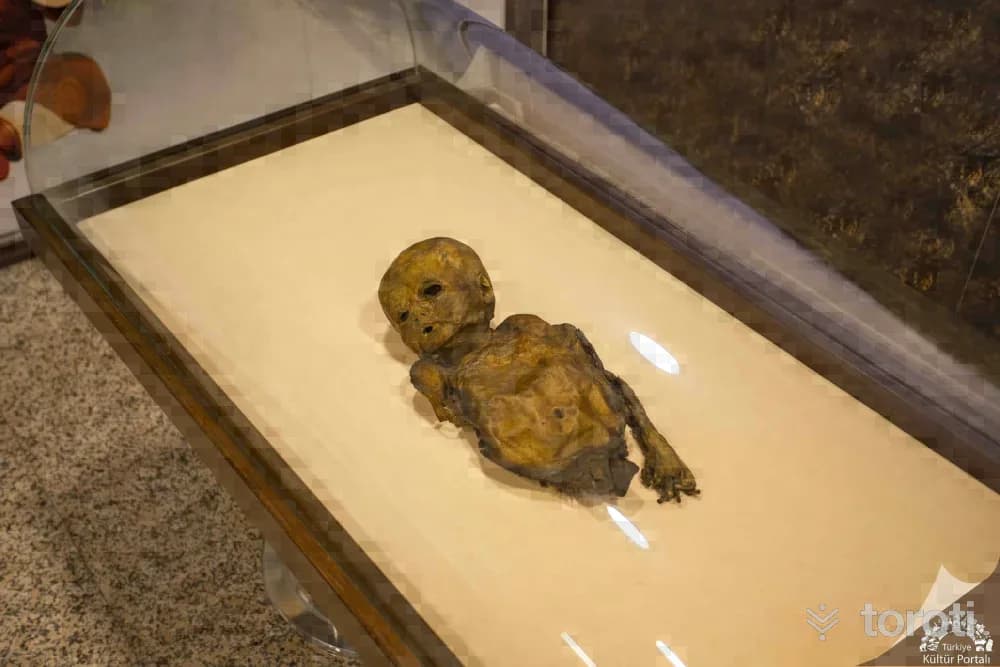
The 14th-century mummies from the Ilkhanid Period, previously exhibited in the tomb belonging to Seljuk Sultan I. Mesud in the museum garden, are exhibited in a special section inside the museum.
Photo: Official Turkish Museums
This section, where the mummies belonging to people who served as nazır and emir in Amasya during the period of Ilkhanid rule in Anatolia and their relatives are located, constitutes one of the most interesting places in the museum.
Photo: Official Turkish Museums
Visitors are allowed to take photographs and videos with amateur cameras in the museum.
Important Artifacts Exhibited in Amasya Archaeology Museum
Window Shutters with Kayı Tribe Stamp
The only Kayı tribe stamp that can be identified within the provincial borders of Amasya, an important sanjak center of the Ottoman period, is found on these window shutters in Amasya Museum. When the subject is considered specifically in terms of the Kayı tribe stamp worked onto wooden window shutters, the application here is the only example in the Ottoman geography.
Photo: Amasya Archaeology Museum
These window shutters were taken from Amasya II. Bâyezid Camii dated 1486 and brought to Amasya Museum on 02.11.2000.
Each of the shutters was arranged in dimensions of 208 x 67 cm and a thickness of 6,5 cm. The shutters were arranged in three panels each; the upper panels were made as horizontal rectangles, the lower panels as squares, and the middle panels where the stamp motif is located as vertical rectangles. On the upper panel of the right shutter, the Persian line Kâ’betü’l-u’şşâk bâşed în mekâm is written, and on the upper panel of the left shutter, the line Her ki nâkis âmed încâ şod temâm is written. This couplet written by Molla Cami is found in the Calligraphy Department of Konya Mevlana Museum, which means in Turkish, “This place is the Kaaba of lovers; whoever comes here incomplete becomes complete.”
The middle panel where the Kayı stamp is located measures 92 x 46 cm. The Kayı tribe stamp, arranged with the symbols I Y I, covers an area with a total length of 29,5 cm.
Photo: Amasya Archaeology Museum
The I-shaped symbols located to the right and left of the stamp are 8 cm high and have a body thickness of 3 cm. The Y-shaped symbol in the middle is 13 cm high, and the distance between the two ends of the upward-facing part is again 13 cm wide. The Kayı tribe stamp was arranged according to the principle of infinity and also in a mirrored style known as müsenna. In this respect, the stamp motifs in question were worked with a remarkably emphasized manner.
Statuette of the Storm God Teşup
It is exhibited in a specially made showcase among the Middle and Late Bronze Age showcases of the archaeology section of the museum. It is the bronze statuette of the Storm God Teşup, the chief god of the pantheon/community of the Hittites, the “People of a Thousand Gods.”
Photo: Official Turkish Museums
The Teşup Statue was found in 1962 at a depth of 4 m from the surface at Mesken Höyük in Doğantepe Village. The area where Doğantepe Village is located is a mound that was inhabited from the Late Neolithic-Early Chalcolithic Age until the end of the Ottoman Period.
The artifact, known in archaeological literature as the Amasya Statuette or the Hittite Storm God Teşup statue, may have been brought for worship to the cult place in Hakmiş/Doğantepe in the Upper Land of the Hittites, or it may be a statue belonging to the temple here. Present-day Doğantepe village was established on the Ancient Hittite City of Hakmiş. Located approximately 150 km from Boğazköy, the capital of the Hittites, Doğantepe was a cultural center attacked by the Kaşkas during the Hittite Imperial Period and was used as an advance fortress by the Hittite Kings.
The artifact, made of bronze by casting technique, has a height of 21.5 cm and a weight of 1340 gr. The arm and leg parts of the artifact could not be found.
Photo: Amasya Archaeology Museum
The part of the statue below the skirt is missing. On its head there is a divine conical pointed headdress. Its lips are in a slight smile, it has thick eyebrows, almond-shaped eyes, and the eye sockets are empty. It is thought that in the original state of the artifact, the eye sockets were filled with precious stones such as lapis lazuli.
Photo: Amasya Archaeology Museum
It is depicted as a young man with a neat slight smile, a strong and proud facial expression, and a delicate body structure.
Sundial
The artifact belonging to the Ottoman Period is a unique work made of marble in the form of a conical pine cone with three bases.
Photo: Amasya Archaeology Museum
On half of the conical body there are reliefs showing 11 hourly time intervals. Inside five of these reliefs, long grooved hollows indicating half-hours were opened.
Mummies
One of the important artifacts exhibited in the museum is the mummies belonging to İşbuğa Nuyin and Cumudar Bey, who served as nazır in Amasya.
Photo: Official Turkish Museums
In addition to these mummies, there are also the mummies of İzzettin Mehmet Pervane Bey, who served as Governor of Amasya under the political sovereignty of the Ilkhanids, his concubine, and his daughter and son.
Amasya Elmalı Mosaic
Amasya Elmalı Mosaic was uncovered in a one-month rescue excavation carried out by the Museum Directorate in 2013 at Küpderesi locality of Yavru Village, located 11 km from Amasya Merkez District. It was understood that the structure was used in two periods. It was first built as a rural villa/villa rustika, and later it was determined that some parts of the structure were closed off and a small apse niche was added to the east wall of room no. 1, transforming it into a small chapel/church.
Photo: Amasya Archaeology Museum
From the architectural texture and changes in the structure, it was understood that the structure was built in the countryside as a villa (villa rustika) in the Roman Period and, after being used for many years, was converted into a chapel from the end of the 4th century AD in the Eastern Roman Period and used as a church. This mosaic is important in showing that the “Amasya Misket Apple” was also famous 1700 years ago.
Photo: Amasya Archaeology Museum
Aktarla Sarcophagus
In antiquity, generally wealthy people were buried after death in sarcophagi decorated with rich reliefs. This sarcophagus exhibited in Amasya Museum is very important in terms of displaying the general characteristics of ancient sarcophagi.
Photo: Amasya Archaeology Museum
The sarcophagus, made of cream-colored limestone and consisting of a chest and a lid, has one side of the outer surface of the rectangular carved chest section where the bodies were placed left plain, while the other sides were adorned in relief with mythological figures and scenes from the Ancient Period. The lid is in semerdam açtı form, with a triangular pediment and corner acroteria. On one of the narrow faces, within the triangular pediment, the figure of two birds eating fruit from a Kanthoros is worked in relief. According to the traces, the lid and the body of the sarcophagus were connected with a bronze rivet. There is a five-line inscription written in Greek letters starting from the place where the lid sits, painted over with red ochre.
Photo: Amasya Archaeology Museum
The Greek inscription reads: “May those who approach the sarcophagus grave with feelings of respect and compassion receive goodness from God; but for those who approach with bad intentions and try to seize the grave or do any other evil, may this world not be trodden and the seas not be crossed. May he not see the good of his children, especially his wife, and may his sustenance decrease.”
In order to protect the grave from tomb robberies in the Ancient Period, the eyes of the Gorgon, located within the frame formed by pilasters on both sides under the inscription on the two narrow faces, were also painted with red ochre.
Places to Visit in Amasya
Source: Amasya Archaeology Museum Address: Üçler, Mustafa Kemal Paşa Cd. D:No.91, 05100 Amasya Merkez/Amasya
According to Wikipedia
This national museum in Amasya, northern Turkey, displays archaeological finds from the city and its surroundings along with ethnographic items related to the region’s cultural history. Founded in 1958, its collection includes nearly twenty-four thousand objects from eleven historic civilizations.
Source: Amasya Museum, Wikipedia (CC BY-SA 4.0). Summarised in our own words.
At a glance
- Type
- archaeological museum, museum
- Built / founded
- 1958
Last updated: 21 October 2026
Location and surroundings
Amasya Arkeoloji Müzesi sits within Amasya merkez, Amasya. The toroti catalogue holds 66 described stops across Amasya, 54 of them in Amasya merkez.
The nearest stop is Sultan Mesut Türbesi, 30 m to the southwest. Another 6 catalogued points lie within a 30 km radius.
The Ankara – Trabzon route passes 2.1 km away, so this works as a stop along the drive.
See Amasya Arkeoloji Müzesi and its surroundings in one plan
- Order your stops on the map and spread them across days
- See driving and visiting time at a glance
- Get places around it suggested automatically
- Free — no sign-up needed to start
Other places nearby
Routes that pass close by
Frequently asked
- What is Amasya Arkeoloji Müzesi?
- The history of Amasya Archaeology Museum, located in the central district of Amasya, dates back to the museum depot established in 1925. The museum depot was formed by bringing together a small number of archaeological artifacts and mummies from the Islamic period in two rooms of the madrasa building of II. Beyazıt Külliyesi. The artifacts in the depot were moved to Gökmedrese Camii in 1962. After being administered by an honorary office until 1958, the depot became a museum directorate in June 1958.
- Where is Amasya Arkeoloji Müzesi?
- Amasya Arkeoloji Müzesi is in Amasya merkez, Amasya.
- How long does it take to visit Amasya Arkeoloji Müzesi?
- The suggested visit time for Amasya Arkeoloji Müzesi is about 45 minutes.
- What else is there to see near Amasya Arkeoloji Müzesi?
- toroti’s catalogue holds other destinations within 30 km of Amasya Arkeoloji Müzesi; the closest are Sultan Mesut Türbesi, Kadilar Türbesi, 2. Bayezid Külliyesi.
- Is Amasya Arkeoloji Müzesi on the way anywhere, and which route?
- Amasya Arkeoloji Müzesi lies 2.1 km from the Ankara – Trabzon route, close enough to add to that drive with a short detour.