
Destination
Kizilören Han
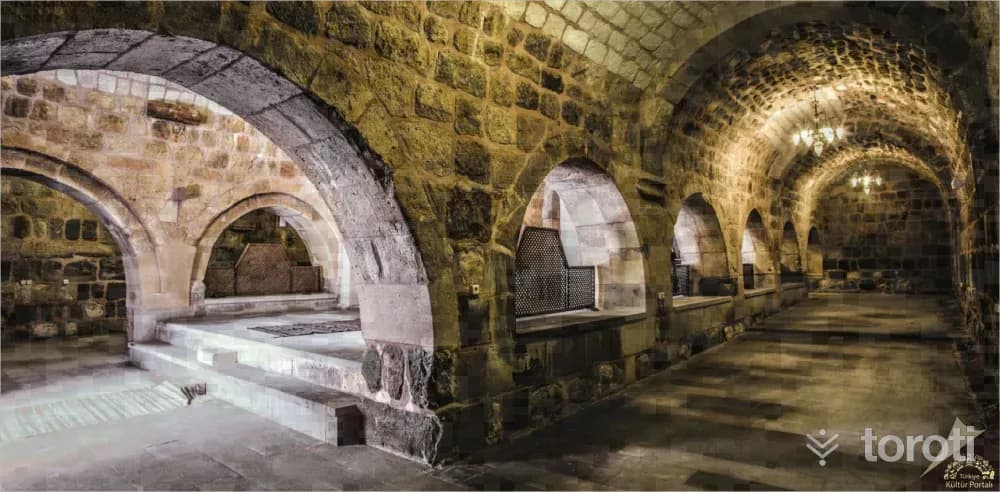
Kızılören Han is on the Konya-Beyşehir route and is also known as “Yazıönü Han”. It was built as two structural masses containing a courtyard and a covered/shelter section on a rectangular planned footprint extending in the northwest-southeast direction.
Kizilören Han and 5 places around it
Free · no sign-up needed
Highlights
- History
Good for
- Cultural routes
Suggested visit:45 minutes
Kızılören Han is on the Konya-Beyşehir route and is also known as “Yazıönü Han”. It was built as two building masses containing a courtyard and a covered/shelter section on a rectangular ground plan extending in the north-west south-east direction. The outer facade walls of the courtyard are supported by one octagonal prismatic corner tower at each corner of the front facade, and by two square prismatic buttresses each at the middle of the side facade and at the east and south corners.
The north-west facade of the han was designed as a three-part and elevated structure attached to the facade as an independent mass. The entrance section of the ground floor, located in the middle of the facade and connecting the exterior space with the courtyard in the form of an iwan arrangement covered with a depressed vault, opens onto the facade with an arch opening of the same form. The square-planned area adjoining the said section from its north wing was built in the form of a baldachin arrangement formed by pointed arches thrown between two free-standing L-planned piers on the front facade and two engaged piers in the wall, and is covered with a cross vault. The remains on its south-east wall adjoining the courtyard indicate that there was a fountain niche on the wall. The square-planned room adjoining the entrance section on the south side and covered with a pointed barrel vault is directly connected with the courtyard. The upper floor of the structure is reached from the courtyard, through the depressed-arched door opening in the south-east wall of the entrance section, and by two separate single-flight staircases with intermediate landings on the rear face of the said wall. It is understood from the stone mihrab in the qibla wall that the rectangular-planned space in the north wing, covered with a cross vault, served as a masjid. The mihrab niche, enclosed from the sides and above by mouldings of different widths and profiles within a rectangular frame, has a semicircular plan and is covered with a conch in the form of a shell. The two rectangular-planned rooms adjoining the masjid and covered with pointed barrel vaults are also entered by means of the door of the room in the south wing; a door on the partition wall connects the two rooms.
The courtyard, extending in the north-west south-east direction, is a rectangular-planned area surrounded by spaces along its long sides. The courtyard is surrounded by four iwans on each side, extending in the north-east south-west direction and covered with pointed barrel vaults placed opposite each other. It is noteworthy that one opposing iwan each at the east and south corners adjoining the wall of the covered/shelter section of the courtyard is connected with one rectangular-planned room each, covered with a pointed barrel vault and placed at the outer corners of the han. Both rooms, which have no windows, were probably storage spaces of the han serving as cellars. The portal of the covered/shelter section forming the south-east wing of the han consists of a rectangular mass projecting outward in the middle of its facade facing the courtyard and rising above the facade walls; the portal niche, surrounded on the sides and above by plain mouldings and borders left unworked, has a simple arrangement consisting only of a pointed arch opening. The covered/shelter section entered through the depressed-arched door opening of the portal is a rectangular-planned space extending in the north-west south-east direction; by means of a total of ten square-planned piers connected to one another by pointed arches, it is divided into three naves covered with pointed barrel vaults. The central nave is wider and higher.
Smooth cut stone and roughly dressed stones were used in the construction of the han. There is no construction inscription; the four-line inscription in thuluth script on marble, known to have been on the portal of the covered/shelter section until the mid-1980s, is no longer there today. As far as could be determined in the 1960s, it is understood from the said inscription that the han was commissioned by Emir Kandemir during the time of the Seljuk Sultan I. Gıyaseddin Keyhüsrev and built in August/September 1206.
Source: Konya Selçuklu Municipality
Places to Visit in Konya Address: Kızılören Mahallesi, Meram/Konya
Last updated: 20 October 2026
Location and surroundings
Kizilören Han sits within Meram, Konya. The toroti catalogue holds 57 described stops across Konya, 11 of them in Meram.
The nearest stop is Kuruçeşme Hanı, 8.2 km to the east. Another 5 catalogued points lie within a 30 km radius.
The Antalya – Konya route passes 160 m away, so this works as a stop along the drive.
See Kizilören Han and its surroundings in one plan
- Order your stops on the map and spread them across days
- See driving and visiting time at a glance
- Get places around it suggested automatically
- Free — no sign-up needed to start
Other places nearby
Routes that pass close by
Frequently asked
- What is Kizilören Han?
- Kızılören Han is on the Konya-Beyşehir route and is also known as “Yazıönü Han”. It was built as two structural masses containing a courtyard and a covered/shelter section on a rectangular planned footprint extending in the northwest-southeast direction.
- Where is Kizilören Han?
- Kizilören Han is in Meram, Konya.
- How long does it take to visit Kizilören Han?
- The suggested visit time for Kizilören Han is about 45 minutes.
- What else is there to see near Kizilören Han?
- toroti’s catalogue holds other destinations within 30 km of Kizilören Han; the closest are Kuruçeşme Hanı, Kilistra, Lystra Antik Kenti, Lukyanus KitÂbesi Ve Atli Kaya Kabartması.
- Is Kizilören Han on the way anywhere, and which route?
- Kizilören Han lies 160 m from the Antalya – Konya route, close enough to add to that drive with a short detour.