Destination
Türk Vakif Hat Sanatları Müzesi
The Turkish Calligraphy Arts Museum is a historical museum located in the Beyazıt district of Istanbul. Opened in 1984, the museum showcases calligraphy arts and various artifacts.
Türk Vakif Hat Sanatları Müzesi and 6 places around it
Free · no sign-up needed
Highlights
- Art
- History
- Culture
Good for
- History lovers
- Families
Suggested visit:60 minutes
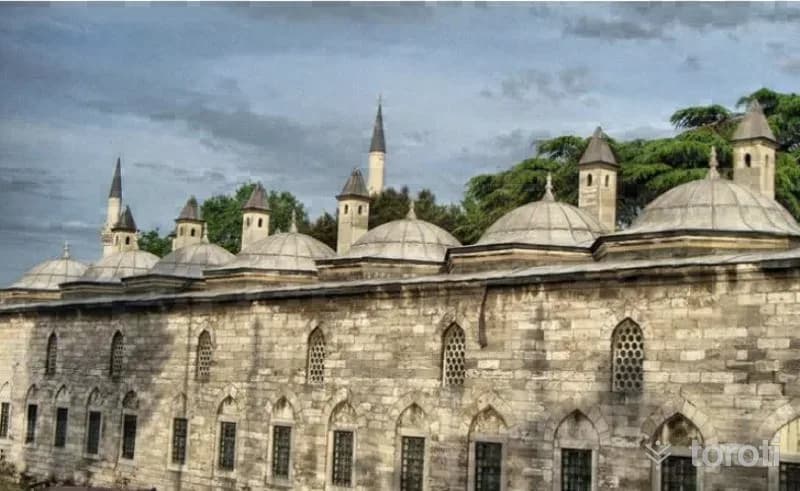
The Turkish Foundation Calligraphy Arts Museum, affiliated with the General Directorate of Foundations and located in Istanbul's Beyazıt District, is inside the Beyazıt Madrasa belonging to the II. Beyazıt Complex. Since there was previously a large rectangular pool to the right of the entrance gate, it is also known among the public as the "Pool Madrasa". It was commissioned by Sultan II. Beyazıt in the years 1506-1508.
History of the madrasa where the museum is located: The construction of the madrasa was completed in 1506-1508. The construction of the mosque dates to 1497-1506, however the endowment deed in the General Directorate of Foundations bears the date 1505. This situation indicates that after the mosque was completed, the complex was included within the scope of the foundation. In the endowment deed of Beyazıt Madrasa, it was stipulated that şeyhülislams should serve as mudarris. However, due to the yoğunluğu of the şeyhülislams' work, it is understood that they appointed deputies in their place for education, and thus the institution of lesson deputyship emerged. II. Beyazıt Madrasa, in the classical madrasa plan, located to the northwest of the mosque and a little apart from it, has an additive appearance with plain moldings on three sides of a central classroom, red and white stones at the entrance, and buds on its crown. After an area with a domed structure resting on diamond-shaped corner pieces and platforms on both sides, one encounters a plain molded door with a low arch. Above the door, there is a pediment composed of Rumî and hatâî motifs made with yellow and black paint. The regular rooms have a nearly square plan. The corner rooms are larger. In the corner rooms, there are three lower and one upper window. The portico has 25 domes. On the left arm there is a passage covered with a vault. The function of this passage is not understood. It is thought, possibly, that it was used for passage to a section connected here. The classroom building is 3.65 metres away from the porticoes and there is only a wall connection between them. It has nine lower and twelve upper windows. There is one cupboard space on each side. There is no fireplace. The dome arch is round, the door arch is of pink and white marble, and the dome drum has eight arches. In front of the entrance door, there is a wooden eave resting on a thin marble column and thought to have been added later.
The şadırvan has an eave with diamond capitals on six columns without a base. The pool section, on the other hand, has eight arches and is a plain work. There is no inscription either on the classroom or on the madrasa gate. The madrasa has undergone many repairs. After the closure of the madrasas, Beyazıt Madrasa was used as a document distribution place, a settlement place for the poor, for a time as a dormitory, and finally as the Municipal Museum and Public Library. After 1943, upon the restoration of Gazanfer Ağa Madrasa, the Municipal Revolution Museum was moved from Beyazıt Madrasa to Gazanfer Ağa and only the library remained here. The Writing Museum, first opened in Yavuz Selim Madrasa in 1968, was opened to visitors on 28 October 1984 under the name Turkish Foundation Calligraphy Arts Museum after Bayezit Madrasa was restored by the General Directorate of Foundations. In the museum, where there are works written on various materials (stone, glass, fabric, metal) as well as manuscript and panel works, there are a total of 3638 works, 277 of which are on display. Sacred relics are also exhibited in the classroom room. The works in the museum are separated according to types of writing and displayed with educational value kept in the foreground. In the museum garden there are two sundials made by Ahmet Ziya Bey.
Places to Visit in Istanbul Address: Istanbul Regional Directorate of Foundations - Turkish Foundation Calligraphy Arts Museum Opposite Beyazıt Camii Camii Beyazıt/ İSTANBUL
At a glance
- Type
- calligraphy museum
- Opened
- 1968
Last updated: 23 October 2026
Location and surroundings
Türk Vakif Hat Sanatları Müzesi sits within Fatih, İstanbul. The toroti catalogue holds 92 described stops across İstanbul, 31 of them in Fatih.
The nearest stop is Kapalıçarşı, 160 m to the east. Another 6 catalogued points lie within a 30 km radius.
See Türk Vakif Hat Sanatları Müzesi and its surroundings in one plan
- Order your stops on the map and spread them across days
- See driving and visiting time at a glance
- Get places around it suggested automatically
- Free — no sign-up needed to start
Other places nearby
Frequently asked
- What is Türk Vakif Hat Sanatları Müzesi?
- The Turkish Calligraphy Arts Museum is a historical museum located in the Beyazıt district of Istanbul. Opened in 1984, the museum showcases calligraphy arts and various artifacts.
- Where is Türk Vakif Hat Sanatları Müzesi?
- Türk Vakif Hat Sanatları Müzesi is in Fatih, İstanbul.
- How long does it take to visit Türk Vakif Hat Sanatları Müzesi?
- The suggested visit time for Türk Vakif Hat Sanatları Müzesi is about 60 minutes.
- What else is there to see near Türk Vakif Hat Sanatları Müzesi?
- toroti’s catalogue holds other destinations within 30 km of Türk Vakif Hat Sanatları Müzesi; the closest are Kapalıçarşı, Nuruosmaniye Camii, Beyazit Kulesi.