Destination
Nuruosmaniye Camii
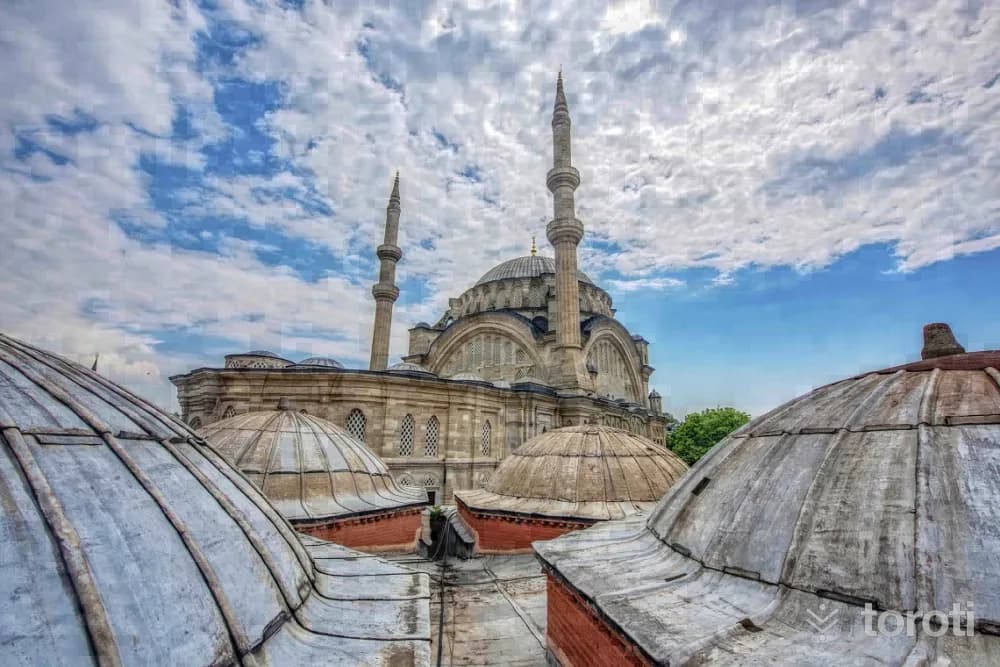
Nuruosmaniye Mosque is an important structure built during the Ottoman period, showcasing the influences of baroque style.
Nuruosmaniye Camii and 6 places around it
Free · no sign-up needed
Highlights
- Historic sites
- Architecture
- Cultural heritage
Good for
- History lovers
Suggested visit:60 minutes
Also known by the names Osmani and Nuruosmani and meaning "the light of the Ottoman," Nuruosmaniye Camii is in the district named after itself. Construction of the mosque began during the reign of Sultan Mahmud I and was completed by عثمان III in 1755. The architect of the mosque is Mustafa Ağa.
Visual: Istanbul in World Literature, Ministry of Culture and Tourism Publications, 2010
Nuruosmaniye Camii is surrounded by a large outer courtyard with two gates. It has surrounding structures such as a madrasa, imaret, library, muvakkit room, sebil, and fountain, as well as shops and an inn around it.
Visual: Nuruosmaniye Mosque Fountain, 1894, Ziya Ağaoğulları collection
The inner courtyard of this characteristic mosque, formed under the influence of the Baroque style, departs completely from the classical plan principle and has 14 domes resting on 12 columns in a semicircular form.
Photograph: Gülcan Acar
The main interior part of the mosque was built on a square plan and its mihrab is projecting. The high dome, whose diameter is quite large, is carried by arches resting on the walls. The mosque is illuminated by 174 windows arranged in five rows, and these windows provide the mosque with abundant light.
Photograph: Gülcan Acar
The windows are made of plaster and are in the Baroque style. At the point where the dome arches end on the wall, the Surah al-Fath is written in a band. The verses on the exterior of the mosque were written by Yedikuleli-Zâde Seyyid Abdülhalim. The celi inscriptions (the name given in calligraphy to the large-written form of every type of script) are the works of the Bursa illuminator Ali Ağa and Kâtip-Zâde Mehmed Refi Efendi.
Source: Fatih District Governorship
Places to Visit in Istanbul Address: Mollafenari, Vezirhan Cd. No:4, 34120 Fatih/İstanbul
According to Wikipedia
Located in the Çemberlitaş neighbourhood of Fatih in Istanbul, this 18th-century Ottoman mosque was completed in 1755. It was designed by Simeon Kalfa in Ottoman and Ottoman Baroque styles and commissioned by Mahmud I, Osman III, and Deli Husrev Pasha. Named after Osman III, it has been on Turkey’s Tentative World Heritage list since 2016 and is recognized as a protected cultural property.
Source: Nuruosmaniye Mosque, Wikipedia (CC BY-SA 4.0). Summarised in our own words.
At a glance
- Type
- mosque, historic building
- Built / founded
- 1755
- Architect
- Simeon Kalfa
- Commissioned by
- Mahmud I, Osman III, Deli Husrev Pasha
- Architectural style
- Ottoman architecture, Ottoman Baroque
- Heritage designation
- Tentative World Heritage Site, cultural property requiring protection
- Named after
- Osman III
Last updated: 23 October 2026
Location and surroundings
Nuruosmaniye Camii sits within Fatih, İstanbul. The toroti catalogue holds 92 described stops across İstanbul, 31 of them in Fatih.
The nearest stop is Kapalıçarşı, 220 m to the west. Another 6 catalogued points lie within a 30 km radius.
See Nuruosmaniye Camii and its surroundings in one plan
- Order your stops on the map and spread them across days
- See driving and visiting time at a glance
- Get places around it suggested automatically
- Free — no sign-up needed to start
Other places nearby
Frequently asked
- What is Nuruosmaniye Camii?
- Nuruosmaniye Mosque is an important structure built during the Ottoman period, showcasing the influences of baroque style.
- Where is Nuruosmaniye Camii?
- Nuruosmaniye Camii is in Fatih, İstanbul.
- How long does it take to visit Nuruosmaniye Camii?
- The suggested visit time for Nuruosmaniye Camii is about 60 minutes.
- What else is there to see near Nuruosmaniye Camii?
- toroti’s catalogue holds other destinations within 30 km of Nuruosmaniye Camii; the closest are Kapalıçarşı, Şerefiye Sarnici, Türk Vakif Hat Sanatları Müzesi.