
Destination
Antiphellos
Antiphellos, referred to as Habesos or Habesa in the Lycian language, is one of the ancient settlements of the Lycian Region. The city, which later took the name Antiphellos, means “the place opposite the rocky place” and “opposite Phellos.” It was one of the member cities of the Lycian League, and it is known to have been the port of the city of Phellos to its north and to have existed since the 6th century B.C.
Antiphellos and 6 places around it
Free · no sign-up needed
Highlights
- Local culture
Suggested visit:45 minutes
Antiphellos, referred to as Habesos or Habesa in the Lycian language, is one of the ancient settlements of the Lycian Region. The city, which later took the name Antiphellos, means “the place opposite the rocky place” and “opposite Phellos.” It was one of the member cities of the Lycian League, and it is known that it was the harbor of the city of Phellos to its north and that it had continued its existence since the 6th century B.C. In the Hellenistic Period, commercial enterprises gained importance, and Antiphellos developed more quickly in contrast to the decline of Phellos, the main city, becoming an important harbor city during the Roman Empire.
From the middle of the 2nd century B.C. onward, Antiphellos was known as a commercial city in the Lycian League through the coins it minted both in its own name and on behalf of the league, even though it was limited to a single vote in the league. The remains of the ancient city within Kaş District continue around the district and along the peninsula stretching in an east-west direction. The remains of Hellenistic walls showing rectangular stonework can be seen at the point where the peninsula begins and on the face looking toward Meis Island. Where the walls face the harbor, to the southeast of the church that has today been converted into a mosque, there are the temenos of a temple whose deity is unknown and certain temple remains. The temenos of the temple was built in bossaged, rectangular wall masonry. The original structure is dated to the 1st century B.C., and the later addition to the 3rd century A.D.
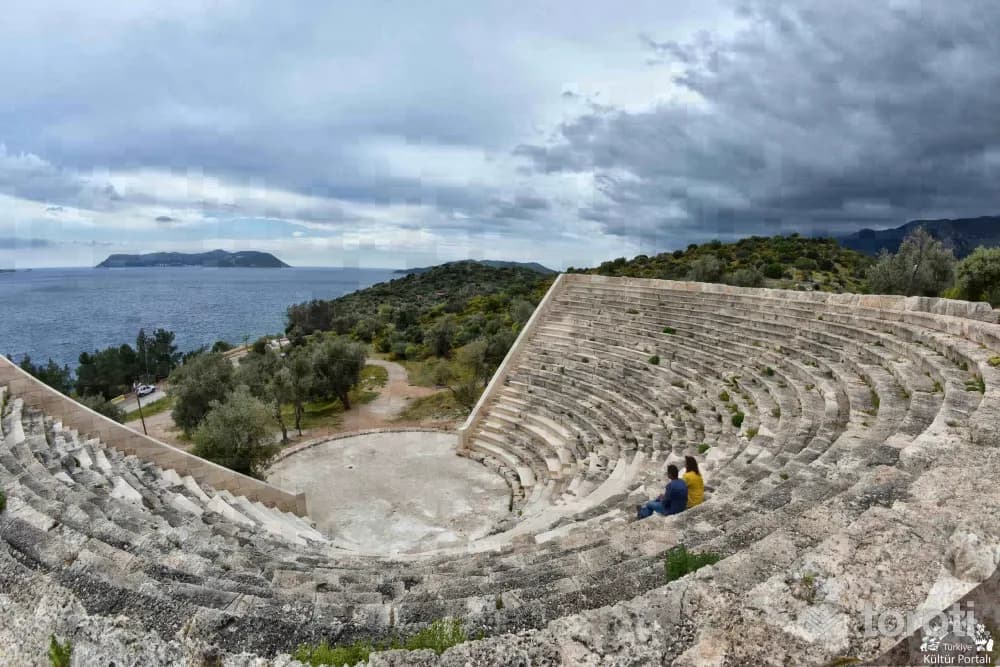
In Antiphellos, the structure better preserved than the temple is the theater. The theater, on the southern slope of the acropolis hill, leans against the hillside and faces the sea with its twenty-six rows of seats (cavea). The seating rows are divided into three sections by four vertical stairways; there is no diazoma. The theater, thought to be a work of the Hellenistic Age, does not have a permanent stone skene building. To the northeast of the theater is a burial chamber carved into the bedrock, containing twenty-four female reliefs. From the form of the women and the facade decorations, it is dated to the 4th century B.C. In the bazaar, there is a tomb with a Gothic pediment, dated to the 4th century B.C., which has become the symbol of Kaş, with very well-preserved lion-head-shaped carrying projections with hyposorion and an inscription in the Lycian language. On the hill that bounds present-day Kaş from the northeast, there are many rock tombs in Gothic style or with Lycian inscriptions. Among these, the most interesting is the tomb whose second story was made in the form of a Gothic arch and which bears a Lycian inscription above it. Centuries later, when the tomb was reused by a woman named Claudia Recepta, a Latin inscription was added. Apart from these, Lycian-type sarcophagi made in later periods, in the water around the harbor and close to the shore, are the other monuments of the city that have survived to the present day.
Source: "Antiphellos", Dünden Bugüne Antalya [II. Cilt], Antalya İl Kültür ve Turizm Müdürlüğü (2012)
Places to Visit in Antalya Address: Çukurbağ Yarımadası, Kaş / Antalya
According to Wikipedia
Antiphellos was an ancient coastal city in Lycia, originally called Habesos. After being settled by the Lycians, it came under Persian control in the 6th century BCE and later gained prominence in the Greek period as the port of nearby Phellus. When Phellus declined, it became a major regional center with the right to mint coins, and in the Roman era it received financial support from Opramoas of Rhodiapolis after the earthquake of 141.
Source: Antiphellus, Wikipedia (CC BY-SA 4.0). Summarised in our own words. · Source: Antifellos, Wikipedia (CC BY-SA 4.0). Summarised in our own words.
Last updated: 19 October 2026
Location and surroundings
Antiphellos sits within Kaş, Antalya. The toroti catalogue holds 133 described stops across Antalya, 15 of them in Kaş.
The nearest stop is Phellos Antik Kenti, 5.4 km to the northeast. Another 6 catalogued points lie within a 30 km radius.
See Antiphellos and its surroundings in one plan
- Order your stops on the map and spread them across days
- See driving and visiting time at a glance
- Get places around it suggested automatically
- Free — no sign-up needed to start
Other places nearby
Frequently asked
- What is Antiphellos?
- Antiphellos, referred to as Habesos or Habesa in the Lycian language, is one of the ancient settlements of the Lycian Region. The city, which later took the name Antiphellos, means “the place opposite the rocky place” and “opposite Phellos.” It was one of the member cities of the Lycian League, and it is known to have been the port of the city of Phellos to its north and to have existed since the 6th century B.C.
- Where is Antiphellos?
- Antiphellos is in Kaş, Antalya.
- How long does it take to visit Antiphellos?
- The suggested visit time for Antiphellos is about 45 minutes.
- What else is there to see near Antiphellos?
- toroti’s catalogue holds other destinations within 30 km of Antiphellos; the closest are Phellos Antik Kenti, İsinda Antik Kenti, Trysa Antik Kenti.