Destination
Nemrut Ören Yeri
Nemrut Ruins are in the Kahta district of Adıyaman. At the ruins, located on Mount Nemrut at an altitude of 2 thousand 150 meters, there are the tomb commissioned by King Antiochos I of Commagene to show his gratitude to the gods and his ancestors, and colossal statues. The most famous king of the Kingdom of Commagene, which ruled the region for approximately 200 years, is Antiochos I (Antiokhos) Theos.
Nemrut Ören Yeri and 6 places around it
Free · no sign-up needed
Highlights
- History
Good for
- Cultural routes
Suggested visit:45 minutes
Nemrut Ruins are in the Kahta district of Adıyaman. At the ruins, located on Mount Nemrut at an altitude of 2 thousand 150 metres, there are the tomb commissioned by Commagene King Antiochos I to show his gratitude to the gods and his ancestors, and colossal statues.
The most famous king of the Commagene Kingdom, which ruled the region for approximately 200 years, is Antiochos I (Antiokhos) Theos. Although the accession dates of the Commagene kings are not known with certainty, sources indicate that Antiochos I ruled approximately between 70-32 BC. Antiochos I declared himself a god (theos) and, while still alive, had a sanctuary built on the summit of Mount Nemrut that would immortalize his name.
Official Turkish Museums
This sanctuary, one of the most magnificent remains of the Hellenistic period, consists of the tumulus, which is the monumental tomb of King Antiochos I, and colossal statues and relief steles positioned on terraces surrounding the tumulus on three sides.
The tumulus, known to be the monumental tomb built by Antiochos I for himself, was formed by piling up small broken rock fragments and pebbles. Today it is approximately 50 metres high and 150 metres in diameter. Although the inscriptions state that the king’s tomb is here, the burial chamber has not been discovered to date. It is thought that the king’s bones or ashes were placed in a chamber carved into the bedrock and protected by creating an artificial hill (tumulus).
The monumental statues of Mount Nemrut are spread over the east, west and north terraces of Mount Nemrut, on three sides of the tumulus. Of the three terraces, the east terrace is the one that has preserved its integrity best to the present day.
Official Turkish Museums
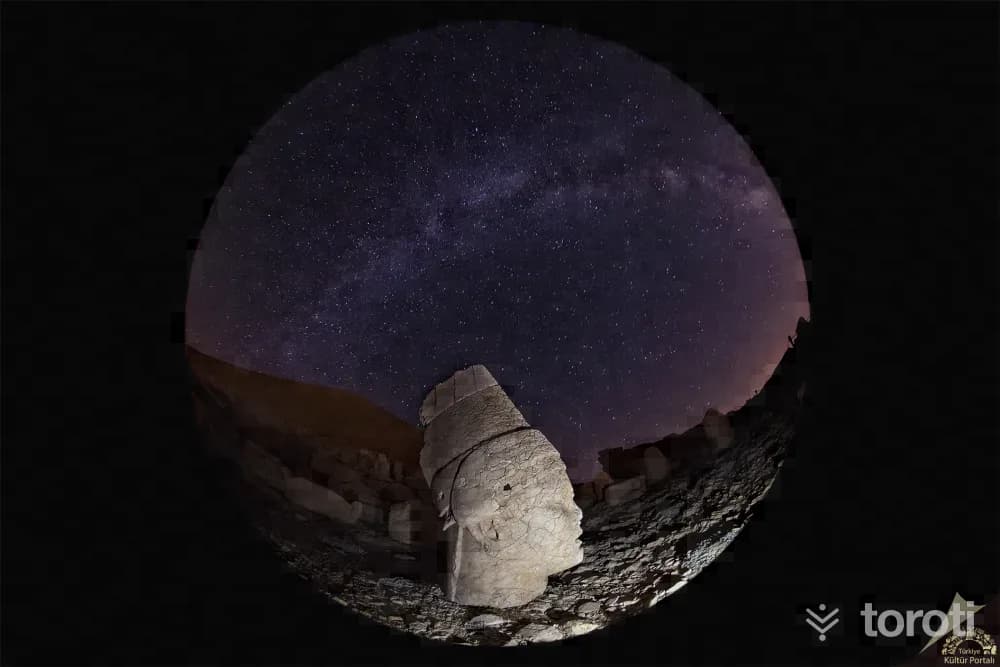
The statues on the east and west terraces are exactly the same apart from minor details. They are in Greco-Persian style and made of limestone blocks. Although their heights reach approximately 8-10 metres, the stone bodies of the giant god statues seated on their thrones are partially collapsed today, and their heads are lined up in front of them.
The god statues, with a lion and an eagle statue placed on either side, are, from left to right, the god-king Antiochos I, the country’s chief goddess Commagene, the chief god Zeus, Apollo and Heracles. The protective lion represents the kingdom’s dominion over the earth; the protective eagle represents the kingdom’s dominion over the sky. The statues are positioned facing the horizon. On both terraces, on the rear faces of the bases forming the thrones on which the god statues sit, there is a 237-line inscription containing the religious and social testament (nomos) of King Antiochos I.
Tanıtma Genel Müdürlüğü Arşivi
On the east terrace there are relief steles of members of the Commagene royal family; in front of the statues there is a fire altar and beside it a seated lion statue. On the west terrace, there are reliefs of Antiochos I shaking hands with the gods. The lion horoscope figure on the west terrace, carved with reliefs of the moon and stars, is under protection today due to damage.
Official Turkish Museums
The north terrace is a ceremonial road 180 metres long connecting the west and east terraces. On the terrace there are stone steles and bases, the great majority of them broken, thought to have been prepared to be decorated with images of the ancestors of Antiochos I.
Mount Nemrut was inscribed on the UNESCO World Heritage List in 1987.
Sources:
Adıyaman Provincial Directorate of Culture and Tourism
Kahta Tourism Information Office website. “Mount Nemrut.”
Yaşar, Mesut (2019). “The Sacred Monument of Mount Nemrut: The Genius of Antiochus I.” İnönü University Journal of Art and Design 9(19), pp. 19-27
Places to Visit in Adıyaman Address: Nemrut Dağı Yolu, 02402 Kahta/Kâhta/Adıyaman
At a glance
- Type
- mountain, archaeological site, sanctuary
- Heritage designation
- World Heritage Site
- Mountain range
- Taurus mountains, Mount Ankar
- Elevation
- 2150 m
- Area
- 11 hectares
Last updated: 21 October 2026
Location and surroundings
Nemrut Ören Yeri sits within Kahta, Adıyaman. The toroti catalogue holds 45 described stops across Adıyaman, 10 of them in Kahta.
The nearest stop is Nemrut Dağı Tümülüsü, 10 m to the northwest. Another 6 catalogued points lie within a 30 km radius.
See Nemrut Ören Yeri and its surroundings in one plan
- Order your stops on the map and spread them across days
- See driving and visiting time at a glance
- Get places around it suggested automatically
- Free — no sign-up needed to start
Other places nearby
Frequently asked
- What is Nemrut Ören Yeri?
- Nemrut Ruins are in the Kahta district of Adıyaman. At the ruins, located on Mount Nemrut at an altitude of 2 thousand 150 meters, there are the tomb commissioned by King Antiochos I of Commagene to show his gratitude to the gods and his ancestors, and colossal statues. The most famous king of the Kingdom of Commagene, which ruled the region for approximately 200 years, is Antiochos I (Antiokhos) Theos.
- Where is Nemrut Ören Yeri?
- Nemrut Ören Yeri is in Kahta, Adıyaman.
- How long does it take to visit Nemrut Ören Yeri?
- The suggested visit time for Nemrut Ören Yeri is about 45 minutes.
- What else is there to see near Nemrut Ören Yeri?
- toroti’s catalogue holds other destinations within 30 km of Nemrut Ören Yeri; the closest are Nemrut Dağı Tümülüsü, Nemrut Dağı Doğu Terası, Nemrut Dağı Batı Terası.