
Destination
Çinili Köşk
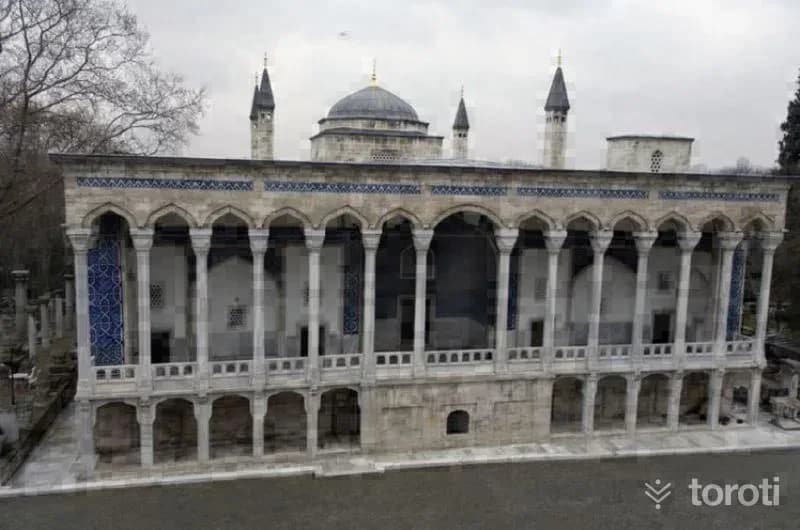
The Çinili Köşk, built by Fatih Sultan Mehmet in 1472, is an important example of early Ottoman architecture influenced by Seljuk design. The museum showcases ceramics and tiles from the Seljuk and Ottoman periods.
Çinili Köşk and 6 places around it
Free · no sign-up needed
Highlights
- Architecture
- History
- Art
- Culture
Good for
- History lovers
- Families
Suggested visit:60 minutes
It is the first building commissioned by Fatih Sultan Mehmet in Topkapı Sarayı, opposite the Archaeology Museum. The two-storey summer pavilion dated 1472 is an early Ottoman example under Seljuk influence with its façade enlivened by columns, its iwan terrace and its cut-tile decoration. A long inscription is located on the entrance wall. The entrance section is a domed space, with vaulted rooms on the sides. Ceramics and tiles belonging to the 13-19 century Seljuk and Ottoman periods are exhibited in chronological order. 16 century İznik-made tiles are among the important works of the museum. The pavilion, commissioned by Fatih Sultan Mehmet in 1472, is one of the oldest examples of Ottoman civil architecture in İstanbul. It was used as Müze-i Hümayun (Imperial Museum) between l875-1891. In l953, it was opened to visitors under the name Fatih Museum, where Turkish and Islamic works were exhibited, and in 1981 it was transferred to the İstanbul Archaeology Museums due to its location.
The entrance façade of the pavilion is single-storey, while the rear side is two-storey. At the entrance there is a 14-column marble portico. The entrance iwan is decorated with mosaic tiles. Various tiles and ceramics from the Seljuk and Ottoman Periods are exhibited in the pavilion, which consists of 6 rooms and a central hall. There are approximately 2000 works in the museum and its depots. In the collections of the Çinili Köşk Museum, there are around 2 thousand works belonging to the Seljuk and Ottoman periods dated from the 11th century to the beginning of the 20th century. The collections of the Museum consist of the works that existed when it was attached to the Directorate of the İstanbul Archaeology Museums in 1981 due to its proximity in location, and works found in archaeological excavations, acquired through purchase, donation and confiscation. The tiles and ceramics selected from these collections are exhibited in a layout continuing from the left of the entrance: Seljuk Period in the room to the left of the entrance, slip technique and Milet ware in the outward-opening iwan on the left side, İznik-made in the five-cornered projecting room together with the central hall, Kütahya-made in the right corner room facing Gülhane Parkı, and Çanakkale-made works in the outward-opening right iwan.
Places to Visit in İstanbul Address: Alemdar Cad. Osman Hamdi Bey Yokuşu Sok. Gülhane Fatih İstanbul
According to Wikipedia
Inside the outer walls of Topkapı Palace, this pavilion is dated to 1472 based on the tile inscription above its main entrance. It was commissioned by Mehmed II and is identified with Ottoman architecture; it was also known as the Glazed Kiosk. Today it is used as a museum building.
Source: Tiled Kiosk, Wikipedia (CC BY-SA 4.0). Summarised in our own words. · Source: Çinili Köşk, Wikipedia (CC BY-SA 4.0). Summarised in our own words.
At a glance
- Type
- museum building, konak
- Built / founded
- 1472
- Commissioned by
- Mehmed II
- Architectural style
- Ottoman architecture
Last updated: 23 October 2026
Location and surroundings
Çinili Köşk sits within Fatih, İstanbul. The toroti catalogue holds 92 described stops across İstanbul, 31 of them in Fatih.
The nearest stop is Eski Şark Eserleri Müzesi, 90 m to the south. Another 6 catalogued points lie within a 30 km radius.
See Çinili Köşk and its surroundings in one plan
- Order your stops on the map and spread them across days
- See driving and visiting time at a glance
- Get places around it suggested automatically
- Free — no sign-up needed to start
Other places nearby
Frequently asked
- What is Çinili Köşk?
- The Çinili Köşk, built by Fatih Sultan Mehmet in 1472, is an important example of early Ottoman architecture influenced by Seljuk design. The museum showcases ceramics and tiles from the Seljuk and Ottoman periods.
- Where is Çinili Köşk?
- Çinili Köşk is in Fatih, İstanbul.
- How long does it take to visit Çinili Köşk?
- The suggested visit time for Çinili Köşk is about 60 minutes.
- What else is there to see near Çinili Köşk?
- toroti’s catalogue holds other destinations within 30 km of Çinili Köşk; the closest are Eski Şark Eserleri Müzesi, İstanbul Arkeoloji Müzeleri, Topkapı Sarayı.