
Destination
Ala Cami
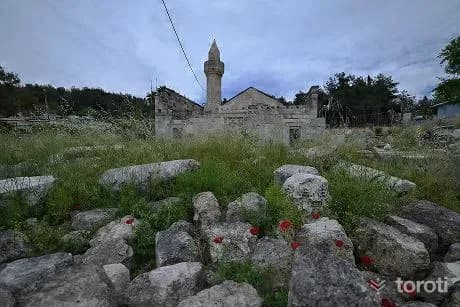
Ala Cami is one of the most important works of Osmaniye, where traces of Roman, Byzantine and Turkish-Islamic Civilizations can be seen. As a result of the excavations carried out by the Osmaniye Museum Directorate, it was understood that Ala Cami was built as a church together with its kyripta and that its entire surroundings were covered with mosaics; while the mosaic areas on the north and west sides were porticoed, the mosaic areas on the east and south were open to the sky.
Ala Cami and 6 places around it
Free · no sign-up needed
Highlights
- Faith heritage
Good for
- Heritage walks
Suggested visit:45 minutes
Ala Cami is one of the most important works of Osmaniye, where traces of Roman, Byzantine and Turkish-Islamic Civilizations can be seen. As a result of the excavations carried out by the Osmaniye Museum Directorate, it was understood that Ala Cami was built as a church together with its crypt (a stone chamber located under a building), that its entire surroundings were covered with mosaics, that the mosaic areas on the north and west sides were porticoed, while the mosaic areas on the east and south were open to the sky. Şar Kırık Kilise, located in Tufanbeyli District of Adana Province, can be given as an example of similar churches with an externally accessed crypt. Bayliss, who prepared numerous publications about the structure, claims that the building was first built as a monastery and that this place may have been a cross center for Christians. The finds obtained after the excavation also support Bayliss’s view. Ala Cami was built as a church in the Byzantine Period and has been used as a mosque since the Dulkadiroğulları period.
Photo: Ali Murat Coruk
Kasım Bey, the son of Dulkadiroğlu Alaüddevle Bozkurt Bey, had a minaret added to the west side of the church and a mihrab added to the south wall of the chapel in the 15th century, and gave this place the name “Alaüddevle Mescidi.” Among the public, however, it is known as Ala Cami.
The studies carried out show that Alacami has 4 different phases.
First Phase (Early Byzantine Period): The first remains belonging to this period are the mosaics in the north. A platform whose floor is covered with mosaics, in whose foundation Roman column fragments and architectural plastic pieces were used as spolia, and a four-step staircase providing access to Ala Cami belong to the Early Byzantine Period. Again, a water structure belonging to the Early Byzantine Period was identified in the southeast part of Ala Cami. The mosaics of this structure, consisting of fine tesserae, suggest that the structure may have been a nymphaion (the name given to monuments erected in Greece and Rome to sanctify nymphs). However, the most important finds belonging to this period were uncovered in the excavations carried out to the south of Ala Cami. In the excavations conducted in the south, a structure oriented east-west and ending with an apse was uncovered. The south wall of the structure continues under the school wall that is still in use today. The floor of this single-naved space has been largely destroyed and has remained below the level of the original floor. The floor bricks identified in the east of the space show that the floor of the structure was covered with brick. The rows of columns continuing westward from the structure and the mosaics found in the western part of this area show that the floor of the porticoed structure located here was also covered with mosaics. According to the terrain, the courtyard of Ala Cami is also at different levels. The courtyard located in the south consists of two sections and again ends in the south with a porticoed section.
Second Phase (Middle Byzantine Period): In this Period, the structure was converted from a basilical-plan church into a single-naved chapel. The apse section of the single-naved space to the south of the structure was closed off with a wall, and a row of columns was placed inside the space.
Third and Fourth Phases (Dulkadiroğulları and Ottoman Period): In this period, a two-part cistern was added to the north of the structure. With the pipes identified to the east of the cistern, it is likely that the waterway was related to the cistern. On the south wall of the cistern there is an inscription meaning Kelime-i Tevhit and the Arabic duhul (entrance). With this identified inscription, the cistern must also have been used in the Ottoman Period. In addition, a ceramic kiln was identified in the southwest of the structure, and it is thought that the numerous garbage pits opened especially on the west and south sides were opened for the waste of the ceramic workshop. These pits must also belong to the Ottoman Period.
Source: Osmaniye Museum Directorate
Places to Visit in Osmaniye Address: 80750 Öksüzlü/Kadirli/Osmaniye
Last updated: 22 October 2026
Location and surroundings
Ala Cami sits within Kadirli, Osmaniye. The toroti catalogue holds 22 described stops across Osmaniye, 7 of them in Kadirli.
The nearest stop is Kadirli Hasan Dede Türbesi, 6.2 km to the north. Another 6 catalogued points lie within a 30 km radius.
See Ala Cami and its surroundings in one plan
- Order your stops on the map and spread them across days
- See driving and visiting time at a glance
- Get places around it suggested automatically
- Free — no sign-up needed to start
Other places nearby
Frequently asked
- What is Ala Cami?
- Ala Cami is one of the most important works of Osmaniye, where traces of Roman, Byzantine and Turkish-Islamic Civilizations can be seen. As a result of the excavations carried out by the Osmaniye Museum Directorate, it was understood that Ala Cami was built as a church together with its kyripta and that its entire surroundings were covered with mosaics; while the mosaic areas on the north and west sides were porticoed, the mosaic areas on the east and south were open to the sky.
- Where is Ala Cami?
- Ala Cami is in Kadirli, Osmaniye.
- How long does it take to visit Ala Cami?
- The suggested visit time for Ala Cami is about 45 minutes.
- What else is there to see near Ala Cami?
- toroti’s catalogue holds other destinations within 30 km of Ala Cami; the closest are Kadirli Hasan Dede Türbesi, Şarlak Şelalesi, Karatepe-aslantaş Milli Parkı.