Destination
Sakin Şehir Göynük
Göynük Houses: Göynük District is quite rich in terms of old Turkish Houses. There are 135 registered residences in the urban protected area of Göynük district. The houses here date to the early 20th century. The roofs of the houses are generally of the hipped roof type and are covered with local tiles. In the living rooms of some houses, there are ceilings decorated with various motifs. The houses were generally built as ground floor plus one or two storeys and have internal staircases.
Sakin Şehir Göynük and 6 places around it
Free · no sign-up needed
Highlights
- Local culture
Suggested visit:45 minutes
Göynük Houses: Göynük District is quite rich in old Turkish Houses. There are 135 registered residences in the urban protected area of Göynük district. The houses here date to the early 20th century. The roofs of the houses are generally of the hipped roof type and are covered with local tiles. In the sitting rooms of some houses, there are ceilings decorated with various motifs. The houses were generally built as ground floor plus one or two storeys and have internal staircases. In front of the houses, there are generally courtyards called "Hayat". In recent years, Göynük has appeared in many films and has become a natural film set.
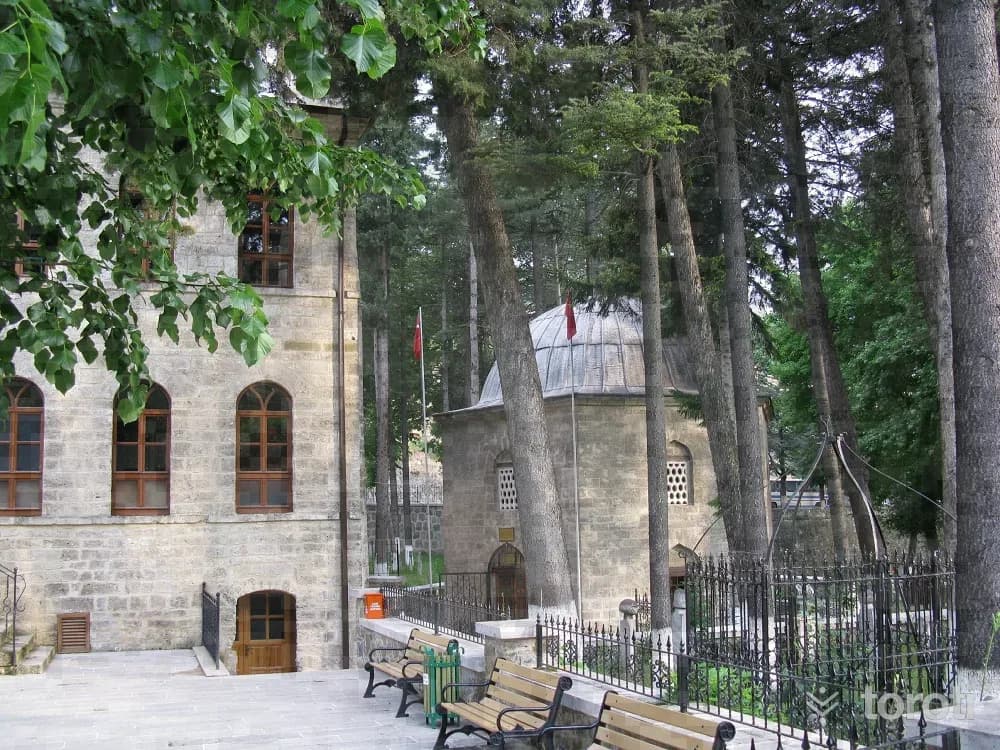
Akşemseddin Tomb: The Tomb of Akşemseddin, who was the teacher of Fatih Sultan Mehmet and died in 1459, is located in the courtyard of Gazi Süleyman Paşa Mosque in Göynük District. After the death in 1459 of this great figure of the Ottoman world of learning, the tomb, commissioned by Fatih Sultan Mehmet in 1464, has a hexagonal plan and is covered with a dome, and its exterior surface is clad with küfeki stones. It has a two-storey window arrangement with pointed arches on each face. Its door is within a pointed-arch niche; above it is the construction inscription. Inside the tomb are the sarcophagi of Akşemseddin and his sons Fakih and Nurihüda Çelebi. The sarcophagus belonging to Akşemseddin is on the right as you enter through the door. The sarcophagus, measuring 2.50 x 0.50 m, is made of walnut wood. The sarcophagus, decorated with relief writing and floral motifs, is a very valuable example of wood craftsmanship. It was restored in 1987. The Tomb of Akşemsettin is visited by thousands of people every year. Various sources have shown that Akşemsettin, who lived between 1387-1459, besides being a scholar of Sufism and religion, was also an important medical scholar of his time and discovered the microbe 4 centuries before Pastör.
Ömer Sekkin Tomb: It is in the district center of Göynük. Although it is claimed that the tomb belonging to Ömer Sekkin, a disciple of Hacı Bayram Veli and a friend of Akşemseddin, was built in 1449, this date is not certain. It was built entirely of cut stone on a high platform. The octagonal-plan tomb is domed. In front of the entrance door, there is a domed portico resting on two columns. On the facades of the tomb, rectangular-framed windows with pointed-arch pediments are placed in alternating order. The entrance door has a pointed-arch pediment and a depressed arch. There is an empty inscription cartouche above the arch. Inside the tomb there is a sarcophagus belonging to Ömer Sekkin.
Göynük Gazi Süleyman Paşa Mosque: It is located in our province's Göynük District, next to the Tomb of Akşemsettin. The mosque, commissioned by Gazi Süleyman Paşa in 1331-1335, was rebuilt in its present form by order of Sultan 2. Abdülhamit after it was destroyed. The mosque, which has a rectangular plan of cut stone, has a wooden ceiling in late-period architectural style and a single minaret.
Gazi Süleyman Paşa Bath: It is located in the district center of Göynük. It was commissioned by Gazi Süleyman Paşa together with the mosque (1331-1335). It is a double bath consisting of men's and women's sections. In both sections there are cold, warm and hot rooms. Cut stone was used in the walls, and rubble stone was used in the drum sections of the domes. Its upper covering consists of domes, fluted domes and barrel vaults. The dome transitions were provided with tromps and Turkish triangles. With the repair it underwent in 1950, the string courses and most of the facade stones were renewed. It is one of the oldest Ottoman baths preserving its original dimensions and plan.
With the values it possesses, our Göynük district was declared "Citta-Slow (Sakin Şehir) Göynük" at the beginning of 2017.
Source: Bolu Culture and Tourism Guide, 2010, Bolu Governorship Provincial Directorate of Culture and Tourism, Bolu
Last updated: 22 October 2026
Location and surroundings
Sakin Şehir Göynük sits within Göynük, Bolu. The toroti catalogue holds 57 described stops across Bolu, 7 of them in Göynük.
The nearest stop is Akşemseddin Türbesi, 20 m to the south. Another 6 catalogued points lie within a 30 km radius.
See Sakin Şehir Göynük and its surroundings in one plan
- Order your stops on the map and spread them across days
- See driving and visiting time at a glance
- Get places around it suggested automatically
- Free — no sign-up needed to start
Other places nearby
Frequently asked
- What is Sakin Şehir Göynük?
- Göynük Houses: Göynük District is quite rich in terms of old Turkish Houses. There are 135 registered residences in the urban protected area of Göynük district. The houses here date to the early 20th century. The roofs of the houses are generally of the hipped roof type and are covered with local tiles. In the living rooms of some houses, there are ceilings decorated with various motifs. The houses were generally built as ground floor plus one or two storeys and have internal staircases.
- Where is Sakin Şehir Göynük?
- Sakin Şehir Göynük is in Göynük, Bolu.
- How long does it take to visit Sakin Şehir Göynük?
- The suggested visit time for Sakin Şehir Göynük is about 45 minutes.
- What else is there to see near Sakin Şehir Göynük?
- toroti’s catalogue holds other destinations within 30 km of Sakin Şehir Göynük; the closest are Akşemseddin Türbesi, Gazi Süleyman Paşa Hamamı, Gazi Süleyman Paşa Camii.