
Destination
Afrodisias Müzesi
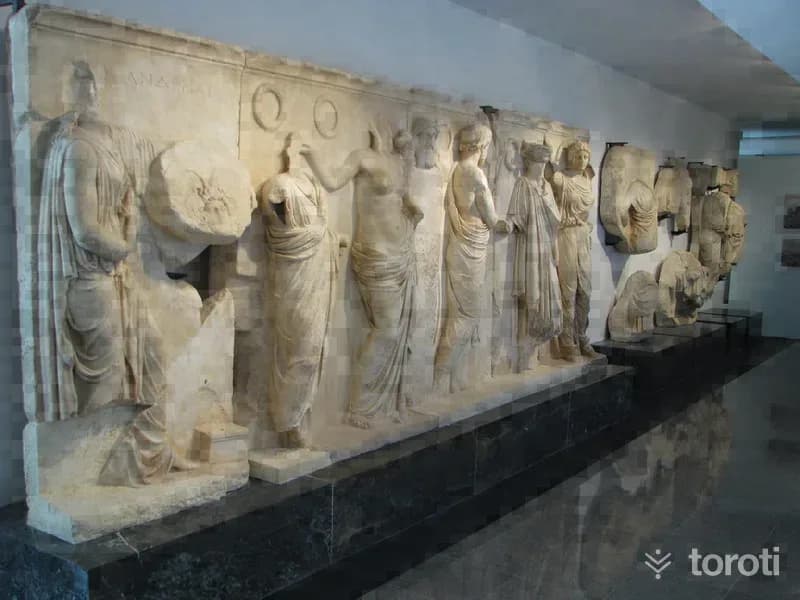
Afrodisias Museum is one of the rare museums where the artifacts unearthed during the excavations of the ancient city of Afrodisias are exhibited and where the museum and the archaeological site are intertwined.
Afrodisias Müzesi and 6 places around it
Free · no sign-up needed
Highlights
- Museum
- Culture
Good for
- Museum visits
Suggested visit:45 minutes
Afrodisias Museum is one of the rare museums where the artifacts unearthed in the excavations of the Ancient City of Afrodisias are exhibited and where the museum and the archaeological site are intertwined. In the small finds hall, prehistoric artifacts covering the Chalcolithic Period and the Early, Middle and Late Bronze Age, unearthed in the excavations carried out at the Akropol Tepe and Pekmez Tepe mounds within the archaeological site area, as well as Lydian ceramics found from these mounds and around the Temple of Aphrodite, Archaic, Classical, Hellenistic period artifacts, and Roman, Byzantine and Early Islamic period artifacts recovered in the excavations carried out at the archaeological site are exhibited.
Afrodisias Museum is quite rich in terms of the sculptural works it exhibits. In this respect, it is an important archaeology museum. With these works made by sculptors from Afrodisias from the white, blue-gray marbles extracted from the slopes of Baba Dağı, a different aspect of Afrodisian sculpture is exhibited in each hall. These halls are the Imperial Hall, Melpomene Hall, Odeon Hall, Glass Display Gallery, Glass Cases, Penthesilia Hall and the Goddess Aphrodite Hall, named after the goddess who gave the city its name; in addition, sarcophagi found in the city are exhibited in the inner garden and courtyard.
The most important part of the museum's collection consists of the numerous statues and reliefs produced by the Afrodisias School of Sculpture, which began operating in the Late Hellenistic Period in the 1st century BC and continued to exist until the Early Byzantine period in the 5th century AD, as well as sarcophagi of various types. Examples of these plastic works currently on display include the Zoilos Frieze, the statue of Melpomene (the muse inspiring tragedy), various emperor statues, the 1st century AD marble copy of Polykleitos's statue called Diskophoros, the Akhilleus – Penthesileia group, the baby Dionysos and Satyr statues, various Nike statues, the cult statue of Aphrodite of Afrodisias, and priest and priestess statues.
It is known that the sanctuary of Aphrodite, which gave the city its name and played an important role in the development of the city's identity, and the original Aphrodite cult in the city also culturally influenced a wide area in the Mediterranean Basin. For these features, the Ancient City of Afrodisias, together with the ancient marble quarries located approximately 2-3 kilometers to its northeast, was inscribed on the World Heritage List in 2017.
History of Afrodisias
Afrodisias was an ancient city known especially for the cult of Aphrodite in the Roman era and had an important school of sculpture. This city, whose monumental structures are very well preserved, is today one of Turkey's most important archaeological sites.
Founded in the 6th century BC on top of a prehistoric settlement dating back to 5000 BC, Afrodisias was initially a small village. The first Temple of Aphrodite was also built in this period. In the 2nd century BC, about 15000 people lived in the city, which was reorganized on a grid plan and spread over an area of approximately one kilometer.
In the 1st century BC, the Roman emperor Augustus took Afrodisias under his personal protection. The ancient city, which gained the monuments still standing today in this period, became the capital of the Caria Province of the Roman Empire at the end of the 3rd century AD and was surrounded by walls in the middle of the 4th century. The city, which began to lose its former importance from the 6th century onward, was completely abandoned in the 12th century.
How to Get to Afrodisias Museum?
It is located in Geyre Neighborhood in Karacasu district of Aydın.
Source: Aydın Provincial Directorate of Culture and Tourism
Places to Visit in Aydın Address: Karacasu - Aydın
Last updated: 22 October 2026
Location and surroundings
Afrodisias Müzesi sits within Karacasu, Aydın. The toroti catalogue holds 71 described stops across Aydın, 5 of them in Karacasu.
The nearest stop is Afrodisias Antik Kenti, 350 m to the west. Another 6 catalogued points lie within a 30 km radius.
See Afrodisias Müzesi and its surroundings in one plan
- Order your stops on the map and spread them across days
- See driving and visiting time at a glance
- Get places around it suggested automatically
- Free — no sign-up needed to start
Other places nearby
Frequently asked
- What is Afrodisias Müzesi?
- Afrodisias Museum is one of the rare museums where the artifacts unearthed during the excavations of the ancient city of Afrodisias are exhibited and where the museum and the archaeological site are intertwined.
- Where is Afrodisias Müzesi?
- Afrodisias Müzesi is in Karacasu, Aydın.
- How long does it take to visit Afrodisias Müzesi?
- The suggested visit time for Afrodisias Müzesi is about 45 minutes.
- What else is there to see near Afrodisias Müzesi?
- toroti’s catalogue holds other destinations within 30 km of Afrodisias Müzesi; the closest are Afrodisias Antik Kenti, Aphrodisias Müzesi, Sirtlanini Mağarası.