
Destination
Istlada Antik Kenti
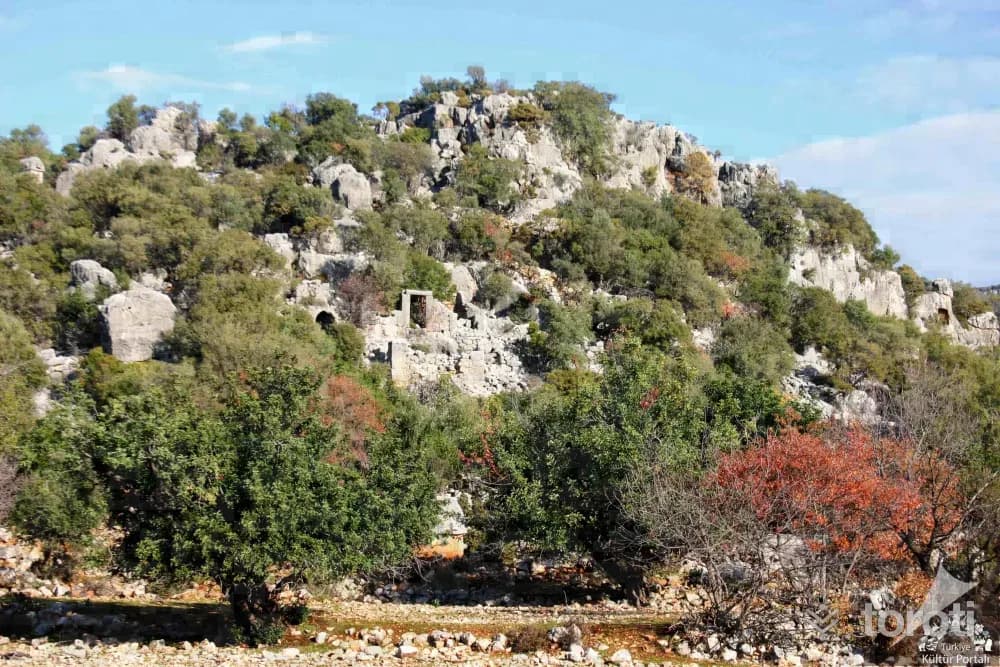
Istlada Ancient City is one of the most impressive small towns of Lycia, notable for its intriguing tombs.
Istlada Antik Kenti and 6 places around it
Free · no sign-up needed
Highlights
- History
- Archaeology
- Nature
Good for
- History lovers
- Families
- Hiking
Suggested visit:120 minutes
Istlada Ancient City is the most impressive among the small-sized cities of Lycia with its interesting tombs that have survived to the present day.
Antalya Provincial Directorate of Culture and Tourism
On the Demre-Kaş highway, after passing Yavu Village, Kapaklı Village is reached 4 km later by the road that turns south from the Davazlar Village sign. The Hayıtlı area, reached by walking ten minutes south again past the famous Hoyran Tomb located directly opposite the village primary school, is the area where the ruins of Istlada Ancient City are located.
The ruins of Istlada are scattered across Kapaklı, Hoyran and Hayıtlı. The name Istlada has been read in many inscriptions of the city, and within the Lycian League it shared the historical fate of the region with other neighboring cities.
Both from the interesting reliefs on the Hoyran tomb and from the readable Lycian inscriptions, it is possible to date the history of the city back at least to the beginning of the 4th century BC.
Antalya Provincial Directorate of Culture and Tourism
It is understood from the ruins that after the Lycian period, the ancient city saw settlement respectively in the Hellenistic, Roman and Byzantine Periods. Istlada has the appearance of a small castle surrounded by walls, where a minor lord resided, like Apollonia, Aperlai, Phellos or İsinda. The city walls extend to the east and west of the acropolis. The wall ends near the eastern end with a gate that provides entry into the castle. Immediately west of the gate, the remains of a structure built to control the gate stand out. Cisterns and wells seen here and there, and channels cut into the native rock that provide water accumulation for them, show that the water need was met by storage. Istlada also has a very special place in the world of archaeology with its relief tomb known by the name of the famous “Hoyran Monument” located in Kapaklı Village.
Antalya Provincial Directorate of Culture and Tourism
The Hoyrat Monument is an example of the main rock being carved and turned into a house-type tomb. In the middle of the pediment, the tomb owner can be distinguished with his wife and son. In the frieze under the very low Gothic pediment, at the center the tomb owner reclines on a couch, while at his feet his soldiers and at his head his son, daughter, wife and a group of women make up those participating in the ceremony. On the acroteria, one of which is broken, there are outward-facing sphinx depictions. The monument is dated to the 4th century BC from the inscription engraved in the Lycian alphabet and the reliefs on it.
Antalya Provincial Directorate of Culture and Tourism
The east and north of the acropolis are full of rock tombs, sarcophagi and single-block tombs in the form of steles. The great majority of the sarcophagi are in the typical Lycian sarcophagus form, consisting of a base, chest and lid. Steles are located among the sarcophagi. All are made of limestone, the natural formation of the region. The rock tombs date to the Classical Age, while all of the sarcophagi date to the Roman Age. Because of the bird depictions on them, the rock tomb known as the tomb with rooster and pigeon is one of the oldest examples and dates to the beginning of the 4th century BC. Another interesting example is the stele-style tomb monument consisting of a single-piece block with a standing warrior relief on it, and it is located in front of the typical rock tomb complex. When looking south from the summit where the ruins are located, Gökkaya Bay and its surroundings, the most striking view of the region, can be seen, and Gökkaya most probably also served as the harbor of Istlada Ancient City.
Source: "Istlada", Dünden Bugüne Antalya [II. Volume], Antalya Provincial Directorate of Culture and Tourism (2012)
Places to Visit in Antalya Address: Istlada Ancient City, Kapaklı Mevkii, Kaş / Antalya
Last updated: 21 October 2026
Location and surroundings
Istlada Antik Kenti sits within Demre, Antalya. The toroti catalogue holds 133 described stops across Antalya, 8 of them in Demre.
The nearest stop is Andriake Antik Kenti, 5.1 km to the east. Another 6 catalogued points lie within a 30 km radius.
See Istlada Antik Kenti and its surroundings in one plan
- Order your stops on the map and spread them across days
- See driving and visiting time at a glance
- Get places around it suggested automatically
- Free — no sign-up needed to start
Other places nearby
Frequently asked
- What is Istlada Antik Kenti?
- Istlada Ancient City is one of the most impressive small towns of Lycia, notable for its intriguing tombs.
- Where is Istlada Antik Kenti?
- Istlada Antik Kenti is in Demre, Antalya.
- How long does it take to visit Istlada Antik Kenti?
- The suggested visit time for Istlada Antik Kenti is about 120 minutes.
- What else is there to see near Istlada Antik Kenti?
- toroti’s catalogue holds other destinations within 30 km of Istlada Antik Kenti; the closest are Andriake Antik Kenti, Kekova Kalesi, Simena.