All articles
Route Guide7 min
The Phrygian Valley: The Quiet Valley 250 km West of Cappadocia
Toroti·August 18, 2026
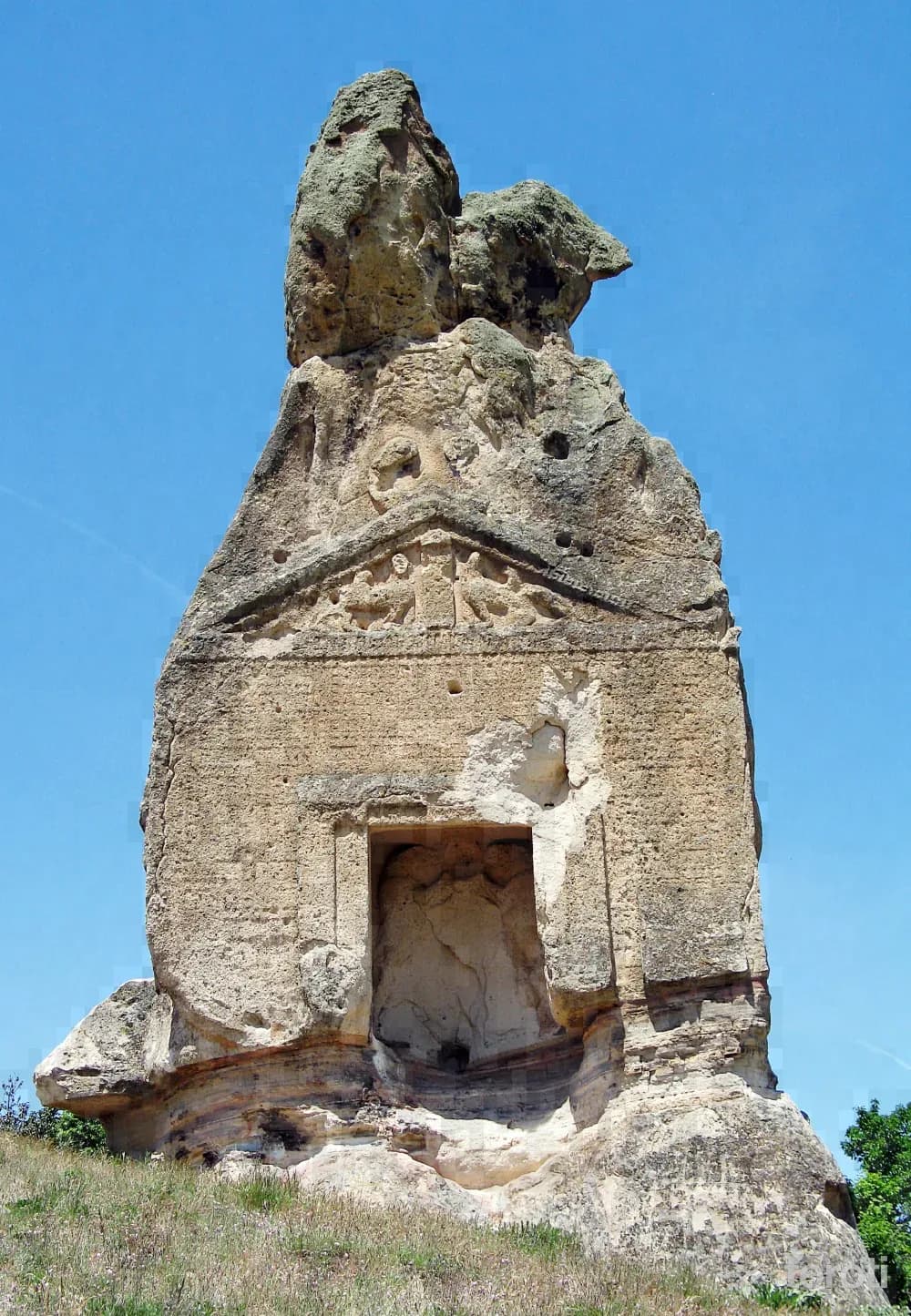
In Turkey, the word "fairy chimney" points to exactly one place. Yet between Afyonkarahisar and Eskişehir there is another valley system carved from the same volcanic tuff — and this one carries monumental rock façades from the 7th century BC on top: the Phrygian Valley.
For the Phrygians, Gordion was the state's most powerful political centre; the Midas City was the kingdom's most important religious centre from its very beginning. That religious centre stands today just west of Yazılıkaya village in Eskişehir's Han district — and the road passing it carries almost no visitors.
What makes the region unusual is how tightly packed it is. Göynüş Valley and Yazılıkaya are only 25 kilometres apart as the crow flies, and nine separate monuments are strung along that gap. This is not a multi-day expedition. It is two well-planned days.
Day 1: Valley of the lions
The route turns northwest off the Afyonkarahisar–Eskişehir highway at kilometre 36. Two kilometres later you reach the Göynüş Valley: sheer rock faces roughly ten metres high, punctuated by small square door openings. Step through them and you find Phrygian rock-cut tomb chambers. The valley holds a fortress along with the Aslantaş, Yılantaş, Maltaş and Kumcaboğaz monuments.
Aslantaş is the valley's signature. On either side of the doorway of the rock-cut tomb chamber stand two imposing lions rearing on their hind legs, each with a cub beneath its paws; above the door, a mass resembling a tree of life, and above that a winged sun disc spreading to both sides — all in relief. It is thought to be the tomb of an important Phrygian king, built in the 7th century BC; more recent examination pushes the date back as far as the 13th century BC.
Ten kilometres west lies Demirli Castle, first used in the Phrygian period and still in use under Byzantium. What is called a "castle" is in fact a natural rock outcrop hollowed into living quarters; a large stepped cistern, now filled with stone, is still visible. Beside it stretches a necropolis of chest-type rock graves and rock-cut tomb chambers.
Then you descend to Lake Emre. Aslankaya, on the shore, is the region's single most striking piece: the south face of a tall rock, cut vertically into a temple façade with a triangular pediment. In the beam recesses of the pediment sit two facing sphinxes — lions with human heads. On the main face, in a niche, Cybele stands between two lions. On the north flank a roaring lion rears on its hind legs. Seventh century BC.
The day closes with two Ottoman buildings. On a hill southeast of the lake stands the Emre Lodge — late 18th century, faced in cut stone, vaulted inside and gabled outside, with Byzantine spolia visible here and there in its walls. Six kilometres away is the Döğer Caravanserai, commissioned by Murad II, with its two-storey inn block and camel stable. The upper rooms were for sleeping, the lower floor for resting; the central iwan served as a small mosque. Its exterior and two dome cones are faced in local cut tuff. It was restored by the Directorate General of Foundations between 1991 and 1993.
Day 2: Cybele's mountain
The morning begins at the Döğer ruins. Döğer has been continuously settled since the Phrygian period: Aslankaya, Kapıkaya I and II, and the 7th-century BC rock monuments that served as an open-air sanctuary to the goddess Cybele are all here. Roman and Byzantine rock settlements, tomb chambers and churches are common throughout the surrounding area.
Three kilometres north, on the slopes of Köroğlu Mountain, rises Asar Castle — a conical mass of rock and hill, its open sections ringed by walls. Inside stand a vaulted cistern and the foundations of religious and administrative buildings. Rock-cut dwellings, a church and embrasures on its eastern side show that it served for defence and observation under Rome and Byzantium.
Then you cross north toward Eskişehir. The Kümbet Valley sits on the ancient road leading to the Yazılıkaya Platform, the religious centre of Phrygian civilisation. On the mound where Kümbet village was founded stand Solon's Tomb (the Lion Temple), used in both Phrygian and Roman periods, and the Himmet Baba tomb. The road from Kümbet to Yazılıkaya runs between fairy chimneys, forests and fields.
And then the end of the route: Yazılıkaya. The platform the Phrygians chose as their religious centre sits within a valley they filled with rock monuments. The Cybele sanctuary and its surroundings were protected by the Phrygian fortresses where the military nobility lived. It is 75 kilometres from Eskişehir, 30 from Seyitgazi.
On the way back, a three-kilometre detour into the Doğanlı Valley reaches the Gerdekkaya Tomb Monument, carved into the east face of a large rock mass. It takes the form of a temple façade in the Doric order, its triangular pediment and cornice carried by two columns. Behind the monumental entrance hall lie two tomb chambers side by side, each with its own door and arched grave troughs along the side and rear walls. It dates to the Hellenistic period (3rd–1st century BC) and remained in use through Roman and Byzantine times with additions. The Eskişehir Museum Directorate restored it in 1991.
Sixty-two kilometres, eleven monuments, two days
The most surprising thing about this route is its density. The distances between stops add up to 62 kilometres, and along that single line the Phrygian, Hellenistic, Roman, Byzantine, Seljuk and Ottoman layers follow one another in sequence.
- Day 1 — Göynüş Valley, Aslantaş, Demirli Castle, Aslankaya, Emre Lodge, Döğer Caravanserai (about 30 km)
- Day 2 — Döğer ruins, Asar Castle, Kümbet Valley, Yazılıkaya, Gerdekkaya (about 33 km)
- Best season: April–June and September–October
- Difficulty: Easy — the route runs mostly on paved village roads
If you would rather skip the crowds of Cappadocia, the same geology sits quietly 250 kilometres to the west.
Sources: Afyonkarahisar Provincial Directorate of Culture and Tourism; Eskişehir Governorship, Eskişehir Guide (5th edition, 2014); Anadolu'nun Kilidi AFYON.
Now turn the ideas into your route
Bring the ideas in this article into your own trip. Open the map, choose the stops and build your route.
Plan your first trip